Politics
Bhutan-India E20 fuel row escalates as Bhutanese editor stands his ground


A war of words has broken out between New Delhi and a Bhutanese newsroom after the Indian government’s petroleum ministry moved to shoot down a report claiming that Bhutan had turned away India’s ethanol-blended E20 petrol.
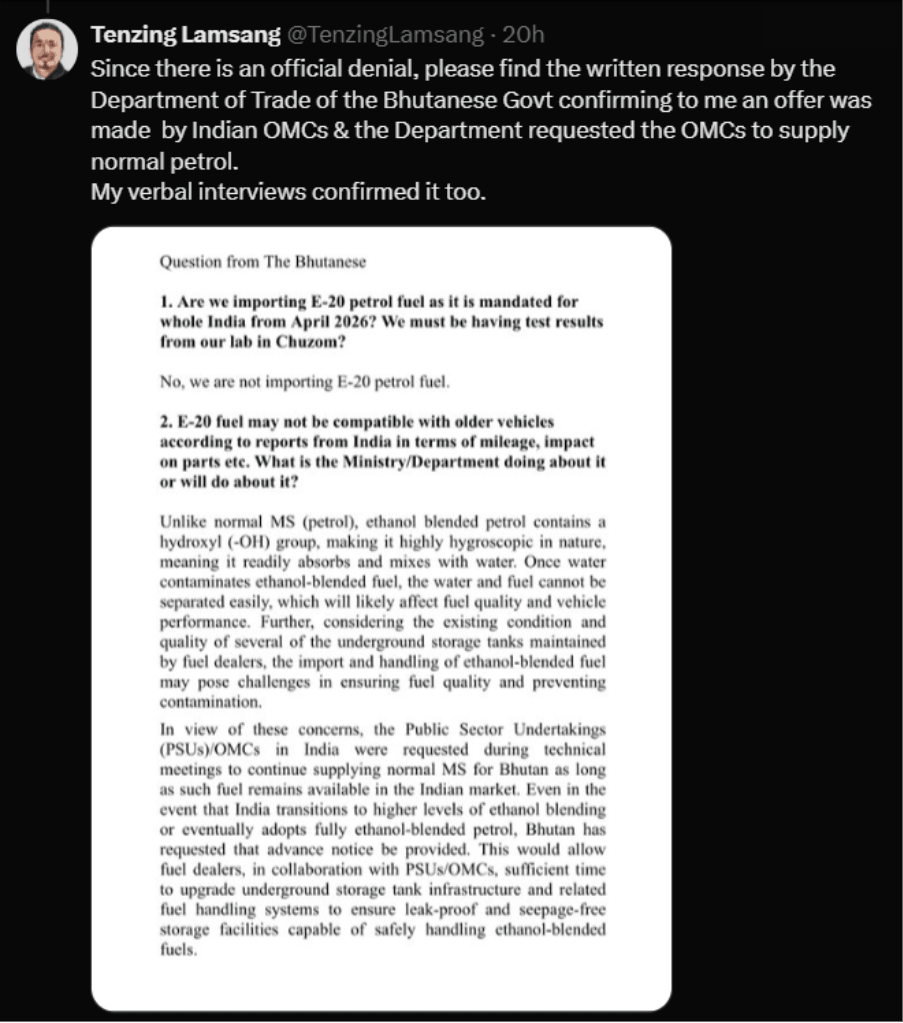
The controversy began when The Bhutanese, edited by Tenzing Lamsang, reported that Bhutan’s Department of Trade had confirmed Indian Oil Marketing Companies had been offering to supply E20 petrol to Bhutan, but that Bhutan had resisted so far. The report cited the department as saying unlike normal petrol, ethanol-blended fuel contains a hydroxyl group that makes it hygroscopic, meaning it readily absorbs and mixes with water, and that once water contaminates the fuel, separating it out again is difficult, which can affect fuel quality and vehicle performance.
The department reportedly went further, noting that Bhutan’s PSUs and OMCs had been asked during technical meetings to keep supplying conventional petrol for as long as it remained available in the Indian market, and that many of the country’s ageing fuel storage tanks, sitting in Himalayan terrain, were prone to some water seepage, which would only compound the risk once mixed with ethanol.
India’s Ministry of Petroleum and Natural Gas was quick to push back. In a fact-check statement, the ministry declared that claims of Bhutan declining an offer to import E20 petrol were incorrect, adding that no such offer had been made by the OMCs and that there was no proposal to export E20 petrol to Bhutan at all. The ministry also urged citizens to rely only on official information from MoPNG and the oil companies.
Rather than retreat, Lamsang doubled down. According to reporting on the fallout, he defended his newspaper’s story and shared a written response he said he had received from Bhutan’s Department of Trade, which he claimed confirmed that Indian OMCs had indeed offered E20 during technical meetings, and that the department had responded by asking them to continue supplying normal petrol instead.
The episode has since taken on a sharper political edge in parts of the Indian press, with some outlets scrutinising Lamsang’s past commentary on India, including old posts where he had described India’s approach to its neighbourhood as seeking complete domination and argued that other South Asian nations had turned to China as a counterbalance. Critics have used this history to suggest a pattern of framing routine bilateral exchanges in adversarial terms, though Lamsang’s core factual claim, that a technical offer of E20 was made and Bhutan asked for conventional fuel instead, remains disputed rather than resolved either way.
Commentators tracking India’s ethanol rollout have pointed out that the row may ultimately boil down to semantics. As one analysis put it, the difference between a “formal export proposal” and a “technical-level discussion” is significant on paper, but easy to blur in translation between bureaucracies, especially when the underlying anxiety, about old storage tanks, hilly terrain and water contamination, is genuine and well documented within India’s own domestic E20 debate.
For now, neither side has produced the underlying document for public, independent verification. India’s official position remains a flat denial that any offer was made. Bhutan’s largest fuel distributor, Tashi BOD, has separately acknowledged that local fuel stations are simply not yet equipped to handle ethanol blends given seepage concerns, a point that lends some credibility to the infrastructure argument even if the “offer versus no offer” question stays unsettled.