
Sports
Spain are World Champions, as Ferran Torres breaks ten-man Argentina’s resistance

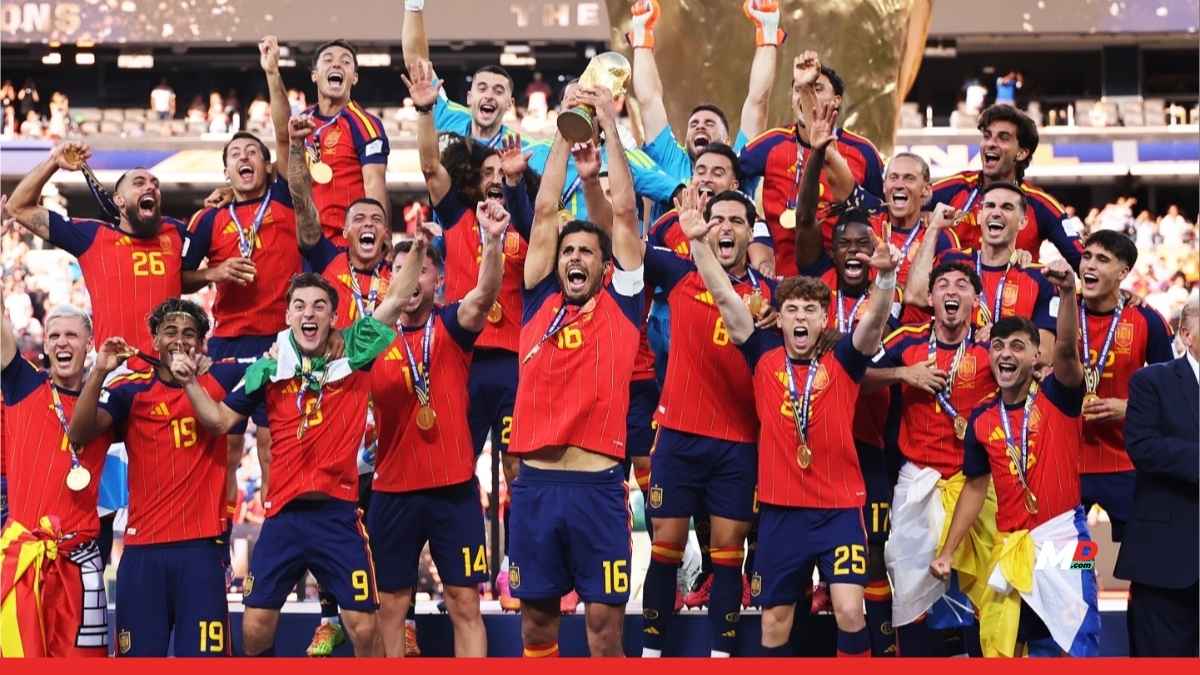
Sixteen years and eight days after Andres Iniesta’s extra-time winner brought Spain their first World Cup, Ferran Torres wrote the next line of that story. His half-volley in the 106th minute at MetLife Stadium settled a final that had refused to give up a goal for well over an hour and a half, sending La Roja past ten-man Argentina and to their second World Cup title.
It was not a night short on drama. Spain, the European champions and the more fluent side for long stretches, dominated possession and territory but found Emiliano Martinez in inspired form between the posts. By the end of normal time, the Argentina goalkeeper had broken the record for saves in a World Cup final, denying wave after wave of Spanish pressure with a mix of instinct and defiance. At the other end, Argentina barely got a sight of goal all evening, finishing the match without registering a single shot on target in 120 minutes, a startling statistic for a side that had arrived in New Jersey as defending champions.
The contest turned in the dying embers of stoppage time. Enzo Fernandez, already on a yellow card, went flying into a reckless challenge on Pau Cubarsi and left referee Slavko Vincic no choice but to show a second yellow and a red. Argentina, so resolute in tight matches throughout the tournament, would have to see out extra time a man short.
They very nearly did. Martinez continued to defy Spain, clawing away a dangerous Lamine Yamal free kick with the last action of normal time and keeping out further efforts as the extra period began. But Spain’s search for a breakthrough eventually paid off. Pedro Porro curled a cross in from the left, Nico Williams rose above Nahuel Molina to win the header and nodded it back across goal, and Torres, a second-half substitute for Mikel Oyarzabal, met it with a thumping finish that Martinez could only watch fly past him.
It was Torres’ only goal of the tournament, and it could not have arrived at a more decisive moment. He becomes only the second substitute, after Mario Gotze in 2014, to score a World Cup final winner. He said afterwards that he had not thought too much about it, that he simply saw the ball coming and struck it with everything Spain had behind him.
For Argentina and Lionel Messi, the final brought a cruel end to what had looked, for much of the tournament, like the perfect farewell. Messi, at 39, had been in exceptional form through the group stages and knockouts, but on the biggest night of all, Spain’s suffocating shape gave him almost no room to operate. There will be no fairytale send-off with the trophy in hand.
The numbers behind Spain’s triumph are extraordinary. They conceded just once across the entire tournament, the fewest goals let in by any World Cup-winning side, and they did it in eight matches, more than any previous champion has had to play. Their run also stretched an unbeaten streak to 38 games in all competitions, a men’s national team record. Head coach Luis de la Fuente, at 65, becomes the oldest coach to lead a nation to World Cup glory. He called it a shared achievement, one the whole squad had reached together.
There were a few tense moments after the final whistle, with some of the Argentinian players (and Leandro Paredes in particular) pushing and shoving players before things were quickly calmed by officials. As Spain’s celebrations began in earnest, the Argentina players sat scattered across the turf in disbelief. De la Fuente and his squad have thus lifted a trophy that had eluded Spanish football for a decade and a half. Sixteen years after Iniesta, another late, decisive goal has crowned Spain champions of the world once more.