

Politics
India’s 11,000-km Coastline Faces Immediate Climate Risks, Warns New Report

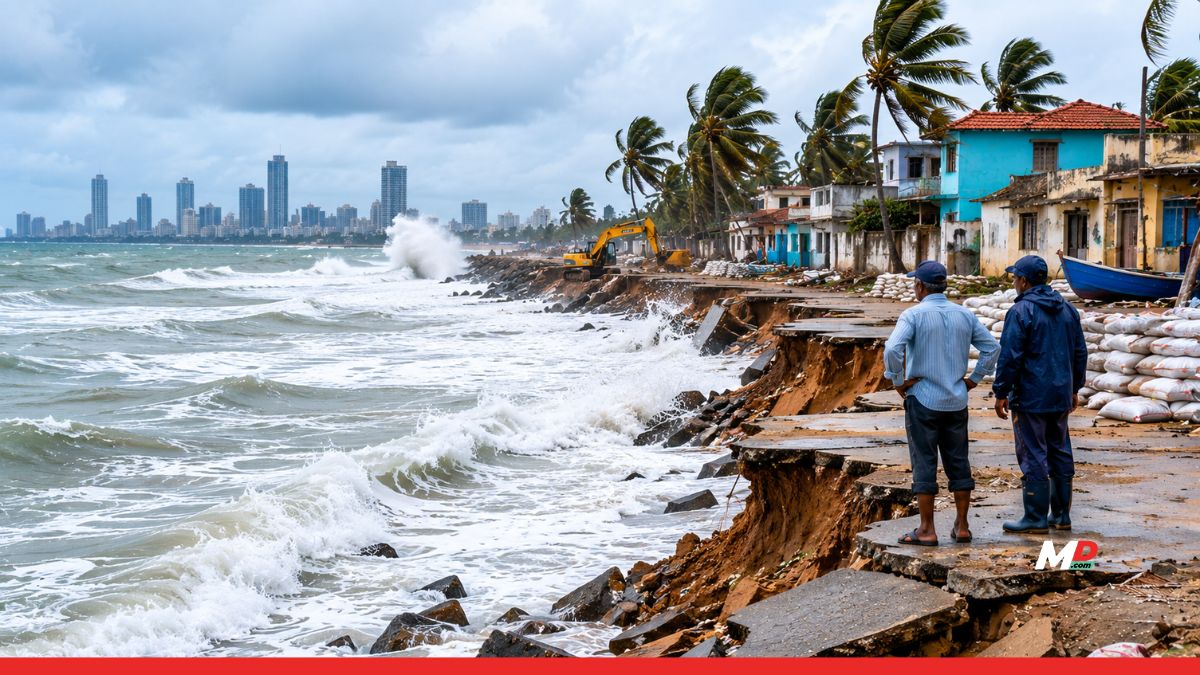
Mumbai: India’s coastal regions are likely to face significant climate-related challenges over the next 15 years, according to a new report released by Azim Premji University. The report, titled Indian Coastal Region: Climate Projections 2021–2040, highlights how rising temperatures, changing rainfall patterns, sea-level rise, and intensifying cyclones could affect millions of people living along the country’s 11,000-km coastline.
Using high-resolution climate data and advanced CMIP6 climate models adjusted for regional conditions, the study provides district-level projections for the period 2021–2040 and compares them with climate patterns from the 1960s. Researchers warn that the global warming threshold of 1.5°C is expected to be reached across India’s administrative regions in the near future, making climate adaptation increasingly urgent.
Anurag Behar, CEO of the Azim Premji Foundation, said climate change is no longer a distant concern but an immediate reality. He stressed that with 2040 only 14 years away, governments and communities must rethink infrastructure planning and governance systems to address growing climate risks.
The report reveals that changing weather conditions are already disrupting traditional knowledge systems and local livelihoods. Rising wet-bulb temperatures in Kerala, intensifying monsoon rainfall in Maharashtra, and shifting weather patterns along the coast are making long-established forecasting practices less reliable.
Harini Nagendra, Director of the School of Climate Change and Sustainability at Azim Premji University, said the findings demonstrate that climate change is now a local and visible challenge affecting daily life across India’s coastline. She emphasized the need to move beyond reactive responses and focus on proactive adaptation measures.
Maharashtra and Gujarat Under Growing Pressure
The report identifies Maharashtra and Gujarat as regions facing major environmental changes. Suburban Mumbai is projected to experience a rise of around 1.3°C in maximum summer temperatures by 2040. The city could also see nearly an additional week of heavy rainfall during the monsoon season.
Meanwhile, Surat and Bhavnagar in Gujarat are expected to witness increases of 23 percent and 24 percent respectively in southwest monsoon rainfall. These changing conditions are already affecting coastal livelihoods. Mumbai’s Koli fishing community, for example, reports losses when unexpected rain disrupts the traditional drying of prawns.
Key Findings
- India’s average temperature is projected to rise by approximately 1.5°C by 2040.
- Around 40 coastal districts could experience summer temperature increases of more than 1°C.
- Coastal areas of Kerala and Tamil Nadu are expected to record dangerous wet-bulb temperatures nearing 31°C, posing serious health risks.
- Ernakulam is projected to witness the highest increase in maximum summer temperatures among coastal districts, rising by about 1.3°C.
- Coastal Maharashtra and Gujarat are likely to receive significantly higher monsoon rainfall.
- Global sea levels could rise by about 15 cm by 2050 under moderate emission scenarios, accelerating coastal erosion and threatening vulnerable communities.
- Rising sea-surface temperatures are expected to increase the intensity of tropical cyclones.
- In Goa, unseasonal rains are damaging salt production, while warming seas are forcing fish farther offshore, affecting small-scale fishermen.
- In the Sundarbans, increasing salinity due to repeated embankment breaches is linked to health problems, including skin diseases and menstrual health issues among women.
The report calls for urgent action to strengthen climate resilience at the district level, improve infrastructure planning, and protect vulnerable coastal communities from the growing impacts of climate change