

Business
Amazon is coming for Blinkit’s quick commerce crown

For three years, India’s quick commerce race has had a settled hierarchy. Blinkit out front, Zepto and Swiggy Instamart fighting hard for second, and a clutch of well-funded but distant challengers bringing up the rear. That hierarchy is now being tested in earnest, and the challenger doing the testing is the one with the deepest pockets of them all.
Also read: Quick-Commerce Shakeout as Funding Model Fails
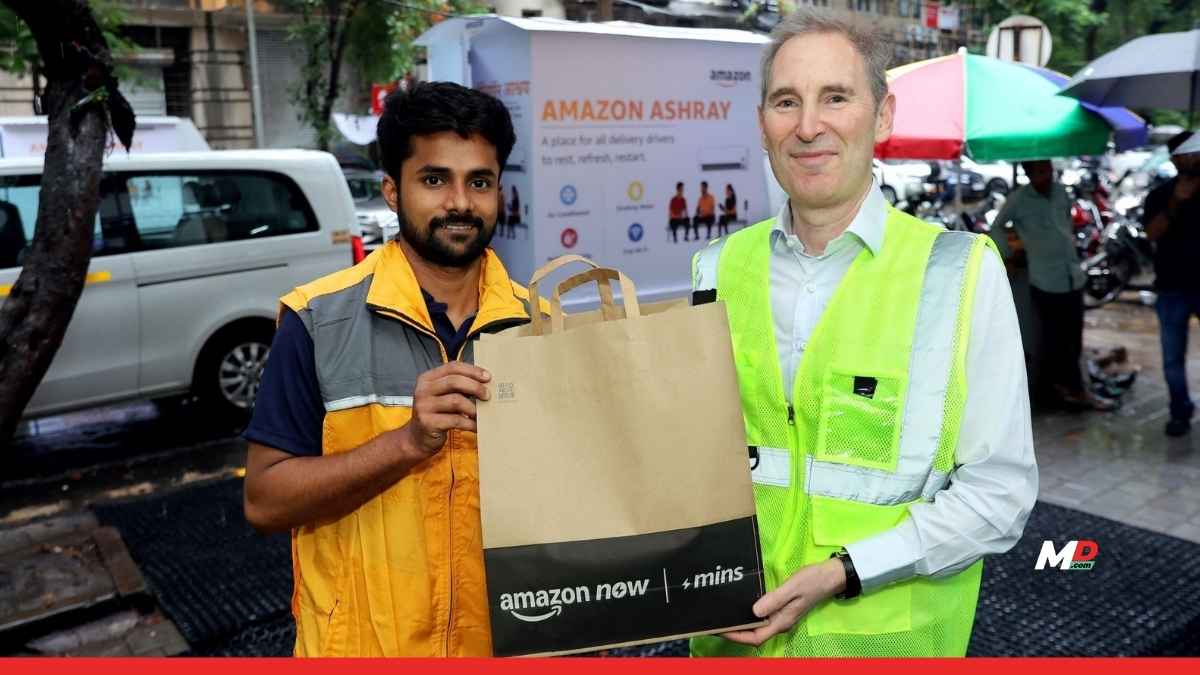
Amazon has announced plans to scale Amazon Now, its ultra-fast delivery service, to over 300 cities across India, calling it an ambition to build the country’s largest delivery in minutes network. The announcement, made during Amazon CEO Andy Jassy’s visit to India, frames Amazon Now as the fastest growing ecommerce business unit in the company’s Indian history, with orders doubling every quarter since launch.
Samir Kumar, Country Manager at Amazon India, pointed to a particularly telling detail: Prime members triple their shopping frequency once they start using Amazon Now. That is the strategic logic in a single sentence. Quick commerce is not a side bet for Amazon. It is a habit-forming wedge into its highest-value customer base.
The scale of intent is hard to miss. Amazon Now is already live for over 50 million customers across more than 15 cities, including Bengaluru, Delhi-NCR, Mumbai, Pune and Hyderabad. Industry estimates from UBS suggest Amazon has already rolled out 450 to 500 dark stores, with 330 to 370 operational. Getting to 300-plus cities and the largest network in the country implies a multi-fold jump from here, backed by an expanded selection that runs from groceries and frozen food to personal care, fashion, beauty and small appliances, all promised within minutes.
Amazon is not arriving empty-handed into a fight that has hardened around unit economics. Blinkit, owned by Eternal, remains the benchmark on scale, running over 2,200 dark stores, processing more than 650,000 orders a day, and holding close to half of market share by most recent estimates. Crucially, it has also turned the corner on profitability, reporting positive adjusted EBITDA in recent quarters.
Zepto has closed the gap on order momentum and is heading towards an IPO, but its losses remain steep. Instamart sits third on most scale metrics, leaning on Swiggy’s wider ecosystem for cross-sell advantages. Against this backdrop, Amazon’s pitch is not speed. Everyone is fast now. Its pitch is depth: the Amazon catalogue, Prime’s loyalty engine, and a logistics network built over a decade and a half in the country.
There is also a quieter, more deliberate signal in the announcement. Alongside the city expansion, Amazon launched Sammaan, a welfare programme for its delivery associates, covering education scholarships for their children, upgraded health and life insurance, and an expansion of rest centres to 250 locations this year, open to any delivery associate in the industry, not just Amazon’s own.
This comes against a backdrop of regulatory scrutiny on the entire sector, including government concern over how the 10-minute promise affects rider safety and pay. By making associate welfare a named, funded programme rather than a talking point, Amazon is positioning itself as the more institutionally mature player in a category that has often been criticised for treating its workforce as an afterthought.
None of this guarantees Amazon the crown. Dethroning a profitable, deeply entrenched leader in a hyperlocal business is a different challenge from winning share in classic ecommerce, where Amazon’s playbook has worked before. But the intent is now unambiguous. With a $300 million investment behind operations and associate welfare, and a network expansion that dwarfs its current footprint, Amazon is committing to quick commerce, city by city, dark store by dark store, for as long as the fight takes.