

Technology
Singapore unveils Data Centre that runs on living neurons

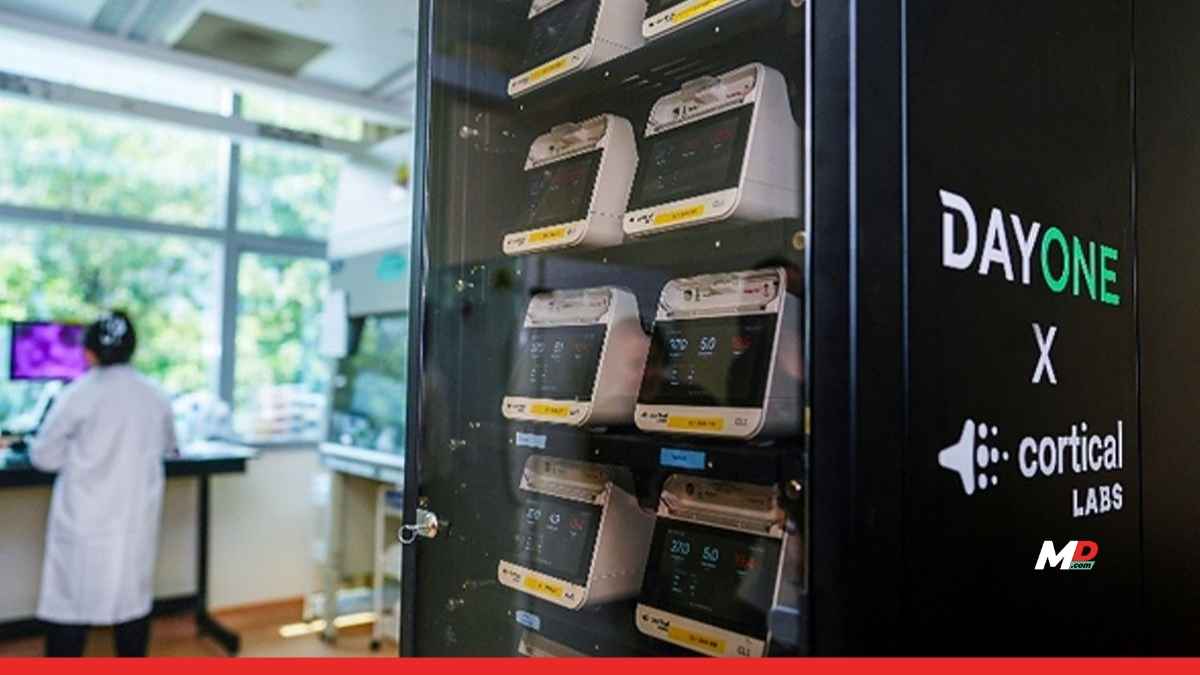
The data centre of the future may have fewer whirring fans, fewer silicon chips, and considerably more biology.
Singapore has unveiled what is being described as the world’s first biological data centre prototype: a server rack that uses living human neurons alongside conventional electronics to perform computing tasks. The system brings together 20 Cortical Labs CL1 biological computers, each incorporating lab-grown human neurons, creating a rather extraordinary hybrid of biology and silicon. According to the companies involved, the rack contains around 16 million living neurons.
Yes, you read that correctly. Somewhere in Singapore, a server rack is alive.
The brains behind the machine
The project is a collaboration between data-centre operator DayOne, Australian biological-computing company Cortical Labs, and the Yong Loo Lin School of Medicine at the National University of Singapore. The idea is not to replace every conventional server with a tiny biological brain. It is to investigate whether living neural networks can perform certain kinds of computing more efficiently than today’s silicon-based systems.
And there is a compelling reason to investigate it. Artificial intelligence is becoming increasingly hungry for computing power. Training and running sophisticated AI models requires enormous amounts of electricity, while data centres themselves are becoming major consumers of energy. Silicon is remarkably good at doing what we ask of it, but the human brain remains an astonishingly efficient biological computer.
Neurons do not process information in quite the same way as conventional processors. They operate through networks of electrical and chemical signals, adapting and learning as they go. Biological computing seeks to exploit some of that flexibility by connecting living neural networks to electronic systems that can stimulate the cells and interpret their responses.
Cortical Labs has previously demonstrated the concept in less conventional surroundings, including experiments in which cultured neurons were trained to play Pong. The Singapore project takes the idea from laboratory curiosity towards something resembling infrastructure.
Still early days
But this is not the moment to start cancelling your cloud-computing subscriptions.
The current installation is a research prototype, and biological computing faces some decidedly un-Silicon-Valley problems. Living cells need the right environment to survive, including carefully controlled conditions and specialist biological support. Unlike a conventional server, which can be powered down and restarted, a biological computing system has an inconvenient relationship with the concept of maintenance.
There are also substantial questions about performance, scalability, reliability, and exactly which workloads biological systems can outperform conventional chips on. The 20-unit Singapore installation is a research platform, not a replacement for the giant hyperscale data centres powering today’s AI boom.
Still, the significance lies less in what this rack can do today than in the question it asks. For decades, computing has largely meant making machines imitate what biology does. Now, engineers are asking whether biology itself can become part of the machine.