
Politics
Delhi and Mumbai protests were a study in contrast and democracy

Dickens said it best: “It was the best of times, it was the worst of times, it was the age of wisdom, it was the age of foolishness, it was the epoch of belief, it was the epoch of incredulity, it was the season of Light, it was the season of Darkness, it was the spring of hope, it was the winter of despair.”
On the same weekend, in two of India’s most important cities, citizens took to the streets with essentially the same demand: Chief Election Commissioner Gyanesh Kumar should step down.
What happened next offered a striking study in contrast.
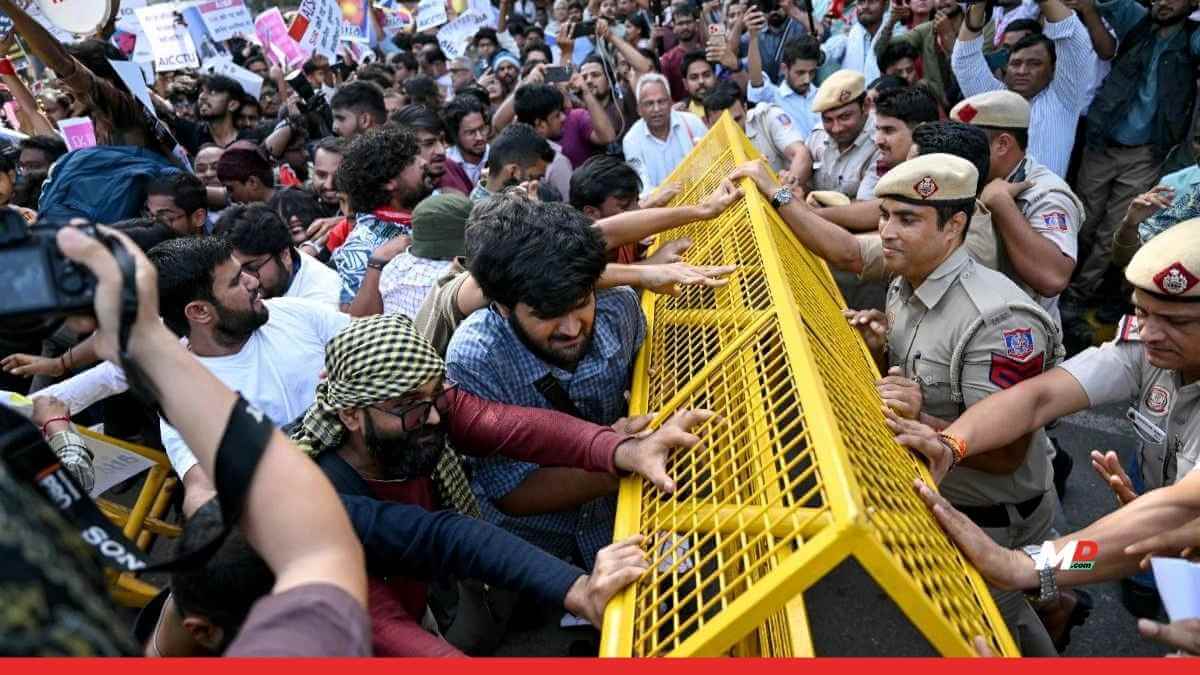
In Delhi, the state responded with barricades, prohibitory orders, closed Metro stations, and mass detention. In Mumbai, the police refused permission for the protest too, but allowed thousands of people to gather, speak, chant, wave the national flag, and go home, while later filing an FIR against the organisers.
One city looked like a confrontation between the state and its citizens. The other looked, in the words of one observer, like a concert.
A tale of two cities
On October 2, Gandhi Jayanti, Delhi Police imposed prohibitory orders in New Delhi and shut 12 Metro stations around the protest zone. Roads were barricaded, and protesters attempting to reach Jantar Mantar were detained. Among those detained were political leaders Atishi, Saurabh Bharadwaj and Manoj Jha, activist Yogendra Yadav, AISA president Neha Bora, and others. Reports put the number of detainees at around 700.
The following day, the detentions continued. Then came something more disturbing. Three women journalists alleged that Delhi Police personnel sexually harassed or manhandled them while they were covering the protests. One complaint involved allegations against ACP Vivek Bhagat. Delhi Police subsequently transferred the complaints to its Crime Branch for investigation. The police have not accepted the allegations as established facts, and the investigation is ongoing.
The episode nevertheless triggered outrage among journalists and civil society groups. On Sunday night, protesters led by CJP leaders gathered outside the Parliament Street police station, demanding that an FIR be registered against the accused officer. The CJP alleged that police had refused to register an FIR against Bhagat. The Delhi Police, meanwhile, said the complaints had been moved to the Crime Branch for investigation.
The Press Council of India and Press Club of India have also called for appropriate action.
Meanwhile, over in Mumbai…
Mumbai offered a very different picture. The Mumbai Police had also denied permission for the Cockroach Janta Party’s proposed protest at Shivaji Park. Organisers nevertheless went ahead, anticipating detention as part of their declared “jail bharo” strategy.
Instead, thousands turned up. The police maintained a heavy presence, monitored the gathering, and managed the crowd without the kind of mass detention seen in Delhi. The atmosphere remained largely peaceful and festive, with speeches, slogans, music, and national flags. There were no comparable reports of violent police intervention.
That does not mean Mumbai Police simply looked the other way. On October 3, Mumbai Police registered an FIR against CJP organisers and hundreds of unidentified participants, citing allegations of unlawful assembly, traffic disruption, sloganeering, and use of loudspeakers without permission. No mass arrests accompanied the action.
The differing approaches made for a fascinating study. A government can enforce the law after a protest without treating the protesters themselves as a threat to be physically neutralised. That appears to be the approach Maharashtra chose.
The Indian Express reported that the BJP-led Maharashtra government had adopted a restrained strategy, with police instructed to avoid excessive force and allow peaceful demonstrations to proceed. The political calculation was obvious enough: a heavy-handed response could have strengthened the Opposition’s argument that the government was becoming intolerant of dissent.
Delhi, by contrast, appears to have chosen containment. Perhaps the government fears a repeat of the student protests earlier this year, when sustained demonstrations over examination irregularities eventually contributed to Education Minister Dharmendra Pradhan’s resignation. Perhaps the authorities believe that allowing a large protest against the Election Commission to gather momentum could create a political spectacle they would rather avoid.
But that raises an uncomfortable question: Why should a constitutional office require such protection from public scrutiny?
The focal point of it all
The Election Commission is supposed to stand above political power. Its credibility rests fundamentally on the perception that it is independent, impartial, and accountable to the voter rather than to the government of the day.
The same principle should apply to the state machinery surrounding it. If citizens believe that voter-list revisions have disenfranchised them, the answer cannot simply be barricades and detention. The Election Commission has defended the Special Intensive Revision as an exercise intended to remove invalid entries, while critics allege that legitimate voters have also been excluded.
That dispute deserves evidence, transparency, judicial scrutiny, and public debate. It does not become less legitimate because the people raising it are inconvenient.
Delhi and Mumbai have therefore offered something larger than two contrasting police strategies. They have offered two competing ideas of democracy. One says dissent must be controlled before it becomes disruptive. The other says dissent can be allowed to happen, managed peacefully, and dealt with through the law afterwards.
Neither approach eliminates the responsibility of the state to maintain public order. But only one leaves citizens with the sense that they are participants in a democracy rather than subjects being managed by it.
The protests are unlikely to disappear. CJP and Opposition leaders have called for the agitation to continue, while further demonstrations are being planned.
The question now moves beyond Gyanesh Kumar. It is about how much political credibility the government is willing to spend defending a constitutional functionary, and why. Because in a democracy, the optics of the state protecting an institution can become almost as consequential as the institution itself. And when Delhi looks like a battleground while Mumbai looks like a political gathering, citizens are entitled to ask why.
The answer cannot simply be that the two cities have different police forces. The deeper question is whether they are being governed by the same democratic instinct. It is one worth preserving and pursuing, for the state is meant to protect and serve the public, not those sitting in the highest echelons of power.