

Politics
Jharkhand police use water cannons, lathis against protesting students

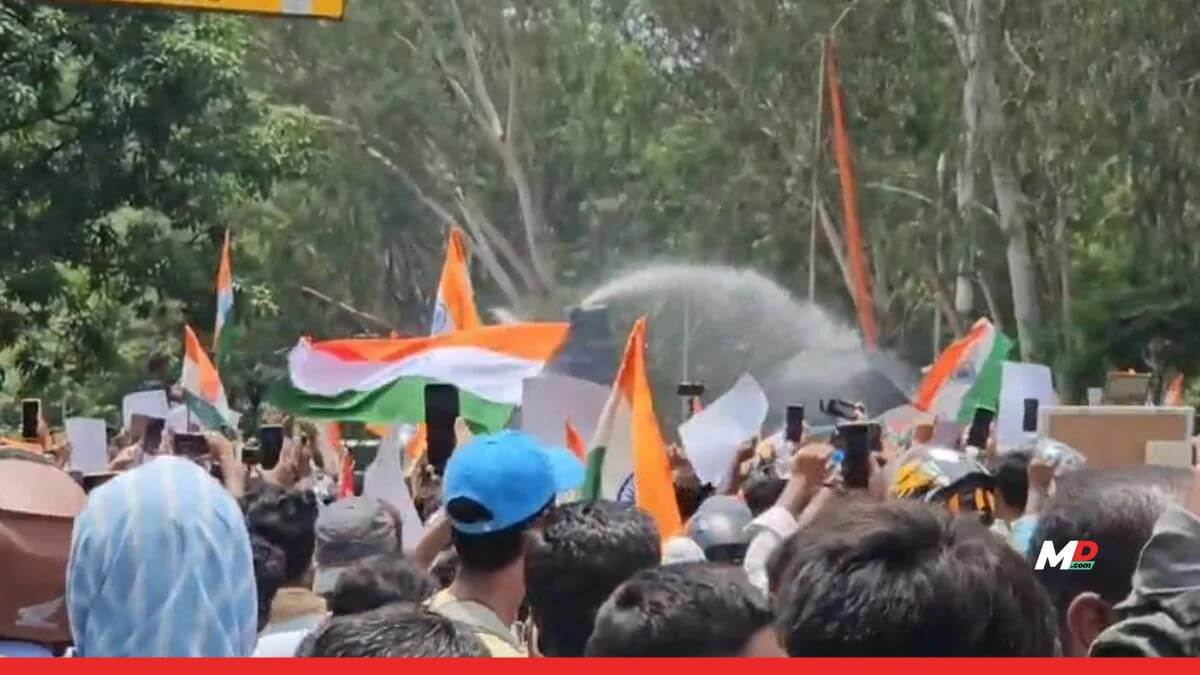
For 17 days, thousands of students have been gathering in Ranchi, demanding answers from the Jharkhand government over alleged irregularities in recruitment examinations. On Monday, their agitation reached a more volatile point, as police used water cannons and lathi charges to disperse protesters marching towards the Vidhan Sabha. Amusingly, the students were barely fazed, and instead celebrated by dancing even as the water cannons pelted them.
The core issue
The students, mobilised under the JPSC-JSSC Reform Manch, are demanding the cancellation of the JSSC-CGL examination and a CBI investigation into alleged irregularities in recruitment tests conducted by the Jharkhand Public Service Commission and Jharkhand Staff Selection Commission. The protest has drawn aspirants from different districts, many of whom travelled to Ranchi by train and bus.
The administration had already imposed prohibitory orders around the Assembly and erected heavy barricading ahead of the march. When protesters breached the barricades, police responded with water cannons and subsequently resorted to a lathi charge.
The confrontation is only the latest escalation in a protest that has been gathering momentum for more than two weeks. At the centre of the agitation is a deeply consequential question: can young Indians trust the examinations that determine access to some of the most coveted government jobs?
Testing times
For many aspirants, these examinations are not simply tests. They represent years of preparation, financial sacrifice and, often, the hopes of entire families. When allegations of paper leaks, procedural irregularities or unfair evaluation surface, the damage extends beyond an individual examination. It undermines faith in the system itself.
The Jharkhand government has maintained that it has accepted around 98% of the students’ demands. The protesters, however, dispute that assessment, pointing out that only three of the 13 tests in question have been cancelled. They continue to demand a CBI probe.
Six protesters remain on hunger strike, while student leader Devendra Nath Mahto has been fasting for nine days. The Enforcement Directorate has also registered an ECIR under the Prevention of Money Laundering Act in connection with alleged irregularities in JPSC examinations. Three JPSC members have resigned after being summoned by the state CID in connection with alleged irregularities and paper leaks.
Students protesting against testing
There is a striking parallel here with the student protests that erupted in Delhi in July. At Jantar Mantar, students and young professionals gathered over allegations surrounding examination and recruitment irregularities. The movement, which had also attracted the support of educator Sonam Wangchuk, eventually saw police use tear gas and batons against protesters during a July 20 march. After much hullaballoo, Education Minister Dharmendra Pradhan was forced to resign.
The geography is different. The examinations at the centre of the dispute are different. But the underlying anxiety is remarkably similar. India has millions of young people competing for a limited number of secure jobs. For them, competitive examinations are supposed to be the great equaliser – a system where preparation and merit can overcome privilege. Every allegation of a leak, manipulation or administrative failure chips away at that promise. That is why these protests deserve to be viewed as more than routine student unrest.
There is also a larger political lesson here. When governments respond to a demand for transparency primarily through barricades, water cannons and batons, they may control a crowd for an afternoon without necessarily addressing the grievance that brought it onto the street.
The real test for Jharkhand is therefore not whether the students can be stopped from reaching the Assembly. It is whether the government can convince them that the examination system they are being asked to trust is worthy of that trust. Because when young people stop believing that merit will determine their future, no barricade is high enough, and no water cannon enough of a deterrent that stops an idea whose time has come.