Sports
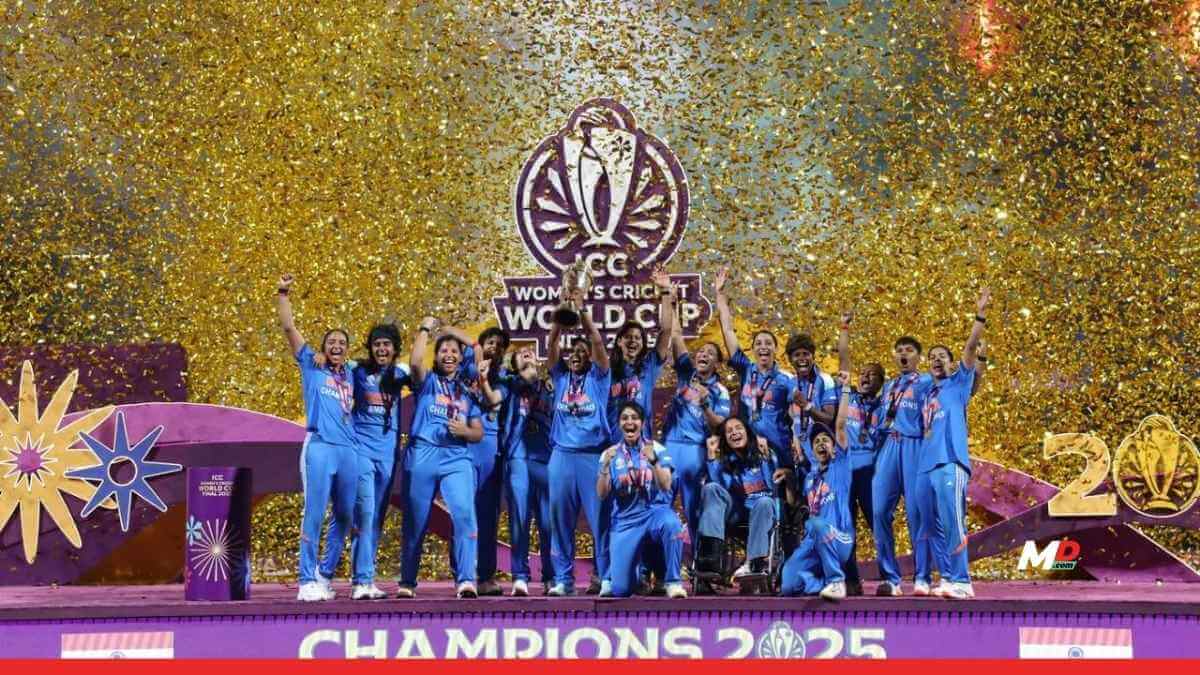
Indian Women’s Cricket team win the World Cup in a historic first

“Kehte hain agar kisi cheez ko dil se chaho toh puri kainaat usse tumse milane ki kishish mein lag jaati hai.”
This might have been a Bollywood dialogue, but it’s so much more than that; it was the heartbeat and inner voice of a billion people who watched, prayed, and believed. For the Indian Women’s Cricket Team, that “cheez” was the World Cup, a trophy that had remained agonizingly out of reach. This desire, however, was not passive hope. It was an active, burning, strategic pursuit. And
When South Africa won the toss and elected to bowl, the strategy was clear: make the most of a wicket that had been under the covers, pick some early wickets, and put pressure on the Indian team. But finals are rarely straightforward, and Shafali Verma and Smriti Mandhana set about making sure a packed crowd got what they came to see; an Indian batting masterclass.
Shafali’s innings was a masterclass in controlled aggression. She respected the opening spells of Marizanne Kapp and Ayabonga Khaka, absorbing the pressure. Then, she began to unfurl. A drive through the covers that was pure timing. A pull shot over mid-wicket that was pure power. This was a strategic dismantling of a high-quality attack.
That century-strong opening partnership set the tone, and while Harmanpreet Kaur (20) and the hero of the semi-final Jemimah Rodrigues (24) were dismissed without making a substantial contribution, one wondered if the wheels would come off the innings, with India looking comfortably poised for 300+.
Deepti Sharma (58) ensured nothing of the sort would come to pass, with a quickfire innings that kept the innings on the boil. There was much for both sides to celebrate at the end of the first innings. For India, putting a formidable 298 on the board was a massive tick on the checklist. With the pressure of runs on the Proteas, the belief was that the target would prove a step too far to the Springboks.
South Africa too would have been reasonably happy with their bowling effort. What looked like a total of 320 at the bare minimum was pegged back by 20 runs, giving their batters a chance to chase down a total and lodge a historic win.
The chase began, and South Africa’s strategy was equally clear. Laura Wolvaardt and Tazmin Brits were methodical. They saw off the new ball. But a runout saw Brits sent home before the 10th over was concluded, breaking the opening stand.
Yet, Wolvaardt remained. She was playing an innings mirroring Varma’s: calm, authoritative, and dangerously effective. She looked set to break Indian hearts, and the game was slipping. Harmanpreet turned to her most reliable asset: Deepti Sharma.
Deepti didn’t just stop the runs; she hunted the wickets. She deceived the South African batters in flight, and swung the pendulum back India’s her way. Ultimately, here five-for included the scalp of the heroic Wolvaardt, who notched a well-deserved century, in vain. The South Africans eventually fell 52 runs short, and the Indian team, and an awaiting nation, was exulatant.
This victory was not just destiny. It was the culmination of a decade-long strategy: the WPL, the investment in infrastructure, the belief in a generation. The “Women in Blue” were, finally, Champions of the World, and Indian cricket once again left its mark on the world.