

Politics
Tharoor slams Delimitation exercise as “Political Demonetisation”

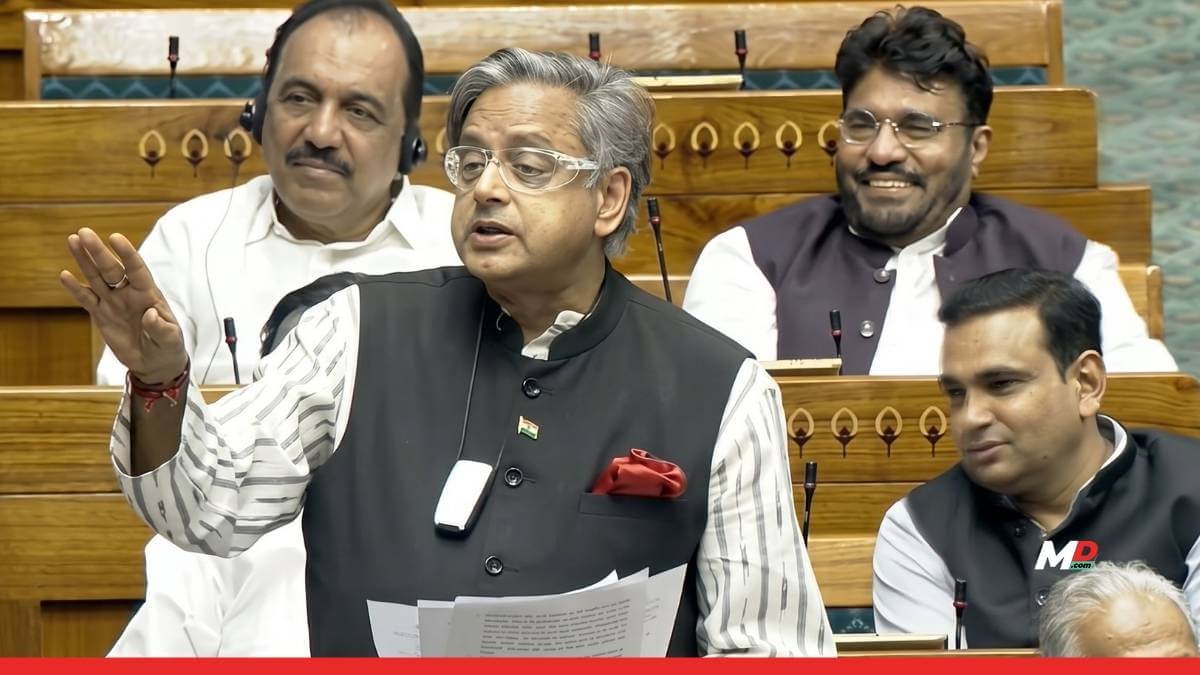
This story covers Congress leader Shashi Tharoor’s recent address in the Lok Sabha, where he strongly criticized the government’s decision to link the implementation of the women’s reservation bill with the upcoming delimitation exercise.
Congress leader Shashi Tharoor launched a fierce critique of the government in the Lok Sabha on Friday. He voiced deep concerns over the decision to link the long-awaited women’s reservation with the highly debated delimitation exercise and the expansion of Parliament. Tharoor warned that tying the implementation of the quota to a complex demographic restructuring would delay a widely supported moral imperative. He characterized the impending delimitation as political demonetisation, cautioning that it risks disrupting the federal balance of the nation.
During his address, Tharoor argued that the aspirations of Indian women are being held hostage to one of the most contentious administrative processes in the country. He noted that there is currently a near unanimous political consensus across major parties in favor of women’s reservation. Politicians recognize that the era of tokenism has ended and a new phase of collective partnership must commence.
Despite this unified stance, Tharoor expressed profound perturbation regarding the current legislative approach. He pointed out that linking the reservation to the 2011 census numbers and future constituency redrawing unnecessarily complicates a straightforward reform.
Tharoor directly addressed the claims made by Prime Minister Narendra Modi. He stated that the Prime Minister says he has brought Nari Shakti the gift of justice, but he has wrapped it in barbed wire. By tethering the implementation of the quota to the expansion of Parliament, the government is entangling a vital step for equality with a demographic minefield. Tharoor emphasized that women’s reservation is ready for harvest right now. It can and should be implemented immediately based on the existing parliamentary strength, without waiting for the future restructuring of constituencies.
The core of his argument rested on the severe political implications of the delimitation process. He clarified that redrawing electoral maps is not merely a bureaucratic task. It represents a profound shift in political power that could tear at the very fabric of Indian federalism. States that have successfully implemented population control measures over the past few decades fear losing their proportional representation in the Lok Sabha. Tharoor stressed that any delimitation exercise is fraught with complications that could deepen regional disparities. The southern states, in particular, have expressed significant apprehension about the potential reduction of their political voice.
Tharoor also drew a sharp parallel between the current legislative haste and the controversial demonetisation policy of 2016. He stated that the government has proposed delimitation with the same speed shown during demonetisation, reminding the house of the damage that policy inflicted on the country. He urged the administration to abandon this rushed approach and allow for extensive deliberations. He pleaded with the government to pass the women’s reservation bill independently today, assuring full support from the opposition benches.
As for the constituency redrawing, he suggested deferring it to ensure a more comprehensive dialogue that considers the larger national interest.
The debate highlights a critical juncture in Indian politics. Both women’s representation and electoral districting carry significant consequences for the democratic structure of the country. By merging these two distinct issues, the government has ignited a fierce political debate regarding fairness, regional equity, and the true intent behind the legislation.
Tharoor concluded his speech by calling for wider consultations with all political stakeholders. He reiterated that while the opposition fully supports the principle of empowering women politically, they firmly believe this empowerment must not be made contingent on a future demographic overhaul. The immediate enactment of the quota remains essential.
This ongoing session will likely determine the timeline and exact mechanism through which female lawmakers gain equal footing in the Indian national legislature. Citizens and policy experts alike are watching closely to see if the government will amend its current trajectory or push forward with a strategy that deeply entwines justice with geographical boundary adjustments.