

Health
India’s mental health challenge begins long before the first appointment


For many people, the journey towards mental healthcare begins long before they enter a therapist’s office or consult a psychiatrist. It begins with sleepless nights, persistent anxiety, strained relationships, an inability to concentrate, or a creeping sense that everyday life is becoming harder to manage. Often, it begins with an attempt to explain these experiences away as stress, a difficult phase, or something that will eventually pass.
By the time professional help enters the picture, months or even years may have elapsed.
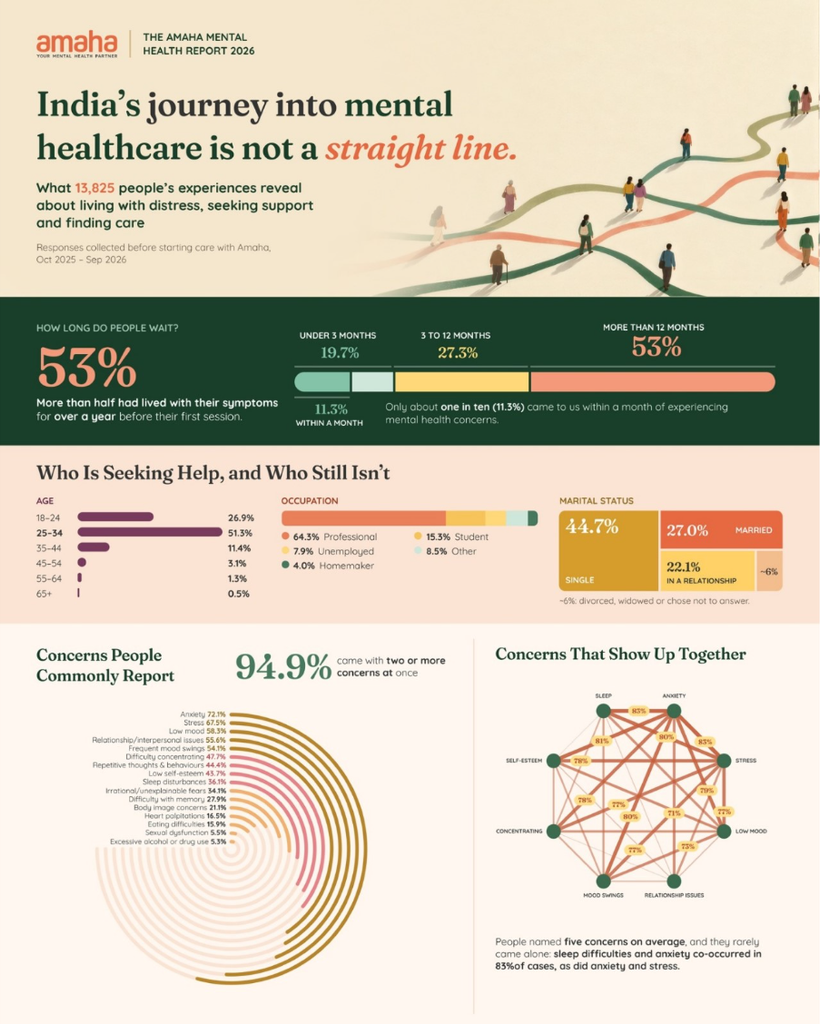
The Amaha Mental Health Report 2026 puts numbers to this often-invisible period. Based on responses from 13,825 people who answered questions before beginning care with Amaha between October 2025 and September 2026, the report, Understanding the Journey to Care in India, found that 53% had lived with mental health concerns for over a year before seeking professional support. Only 11.3% reached care within a month of experiencing their concerns.
The findings offer a closer look at what happens before people seek treatment, including whom they turn to, how they cope, and how distress can affect their ability to function in daily life. They also raise a larger question for India’s evolving mental health conversation: how can greater awareness translate into earlier access to effective care?
The long road from distress to treatment
For most people, seeking professional support is rarely the first response to emotional distress. Friends and family are often the first port of call, while self-help strategies offer a way to manage difficult feelings without immediately entering the healthcare system.
In the Amaha report, 54.5% of respondents said they had spoken to friends or family, while 44.6% had tried self-help. Previous contact with formal care was also common: 32.9% had tried therapy, and 19.4% had been prescribed medication.
These numbers suggest that the journey to care can involve several attempts to understand or manage distress before a person finds a form of support that works for them. The delay is especially important in a context where mental health concerns can affect relationships, education, employment, and the ability to carry out routine responsibilities.
Dr. Amit Malik, Psychiatrist, Founder and CEO of Amaha, said: “India’s progress in mental health must be judged by whether people can get timely, effective care, not simply by how openly we talk about it. These are the accounts of people who reached us; they should make us ask who is still unable to access care. Friends, families, and communities are a vital part of the care ecosystem. They help people make sense of what they are experiencing, recognise the support they need, and help them find their way to care. Finding treatment should not become another test of a person’s resilience. The responsibility is ours to make that journey easier, and to bring clinicians, families, and communities together to support the person, with the person’s own voice shaping decisions about their care.
Our ambition must go beyond delivering treatment to helping people return to work, rebuilding relationships, and living their best version possible, with greater independence. That is what progress should look like.”
His comments point towards a broader understanding of mental healthcare, one that considers the circumstances in which people seek help and the support they need beyond clinical treatment.
Coping mechanisms can conceal the scale of distress
The period before treatment can also be marked by coping strategies that provide temporary relief while making it harder to recognise when professional support may be necessary.
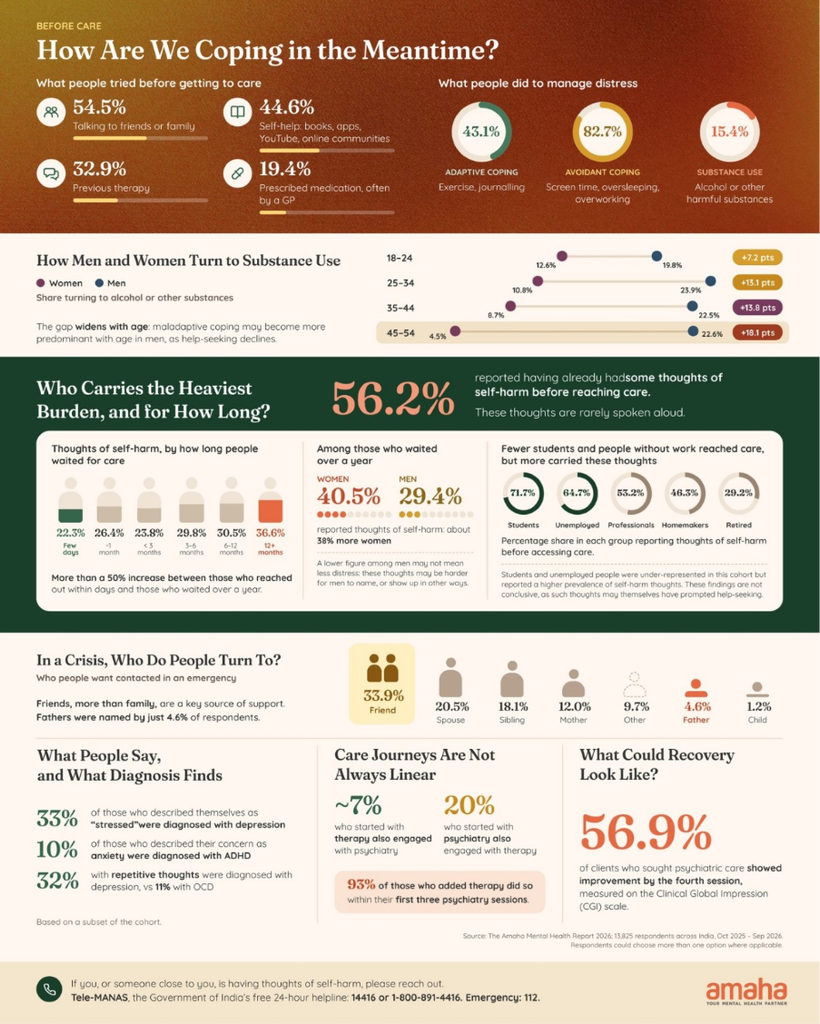
According to the report, 82.7% of respondents reported avoidant coping strategies, including excessive screen time, oversleeping, and overworking, before accessing care. By comparison, 43.1% reported adaptive strategies such as exercise or journaling. Respondents could select more than one coping strategy.
Alcohol and other harmful substances featured in the responses of 15.4% of participants. Men were more likely than women to report using alcohol or other harmful substances across every age group from 18 to 54, with the gap widening with age.
Among respondents aged 18–24, the figures were 19.8% for men and 12.6% for women. In the 45–54 age group, they were 22.6% and 4.5%, respectively.
The findings underline the importance of understanding how people respond to distress, rather than assuming that everyone recognises their experiences as a mental health concern. Coping behaviours can become part of everyday routines, making it difficult for individuals, families, and colleagues to recognise when additional support is needed.
When distress becomes difficult to manage
One of the report’s most concerning findings relates to thoughts of self-harm. More than half of respondents, 56.2%, said they had experienced such thoughts before seeking care.
The figure was higher among students, at 71.7%, and unemployed people, at 64.7%, compared with 53.2% among working professionals.
These figures require careful interpretation. They describe people who had already reached the point of seeking professional support through Amaha and cannot be treated as estimates for India’s overall population. Even within that group, however, they highlight the severity of distress that can precede treatment.
The report also found that many people were struggling to manage everyday responsibilities by the time they accessed care. Only 12.3% said they could manage all their daily tasks, while more than a quarter, 27.3%, could not manage most of them, or any at all.
This has implications beyond the individual. Mental health difficulties can affect participation in education, workplace performance, relationships, and the ability to maintain routines. For employers, educational institutions, and families, recognising changes in functioning can be an important part of encouraging someone to seek support.
Mental health rarely arrives one concern at a time
The report found that 94.9% of respondents reported two or more concerns at once, with people naming an average of five concerns each.
Anxiety was the most commonly reported concern, at 72.1%, followed by stress at 67.5%, low mood at 58.3%, relationship or interpersonal difficulties at 55.6%, and frequent mood swings at 54.1%. Sleep difficulties also frequently overlapped with other concerns: among respondents who reported sleep difficulties, 83% also reported anxiety.
Such overlaps help explain why the first words people use to describe their experiences may not capture the full picture.
In a subset of the cohort, 33% of those who described themselves as stressed were later diagnosed with depression, while 10% of those who identified anxiety as a concern were diagnosed with ADHD. Among people who described repetitive thoughts and behaviours, 32% were diagnosed with depression and 11% with OCD.
These findings do not mean that stress indicates depression or that anxiety indicates ADHD. They illustrate why self-described symptoms are a starting point for professional assessment, rather than a diagnosis in themselves.
Early assessment can help establish what someone is experiencing and identify an appropriate course of care, particularly when several concerns overlap or affect daily functioning.
Building a more connected care ecosystem
The report also offers insights into how people move between different forms of treatment. About 7% of those who started with therapy went on to see a psychiatrist as well, while 20% of those who began with psychiatry also took up therapy. Among those who sought therapy after starting psychiatry, 93% did so within their first three psychiatry sessions.
Among people receiving psychiatric care, 56.9% showed improvement by their fourth session, as rated by clinicians on the Clinical Global Impression scale. This finding applies to psychiatry clients only and should not be interpreted as an overall recovery rate.
Together, these findings point to the value of care pathways that can respond to different needs over time, with clinicians able to assess progress and consider additional support where appropriate.
Founded in 2016 by Dr. Amit Malik, Amaha offers services spanning digital self-care, outpatient and inpatient treatment, and community support. It operates nine centres across Bengaluru, Delhi NCR, and Mumbai, with services available in over 15 languages. The organisation says it has delivered over 450,000 therapy and psychiatry sessions and served over 100,000 clients across 65 countries. Its clinical network comprises over 270 mental health professionals, and its peer support communities have over 65,000 members. It also partners with approximately 120 organisations on workplace mental health programmes.
The wider challenge, however, extends beyond any single provider. Awareness campaigns, workplace initiatives, community support, and clinical services all have roles to play in helping people recognise when they need assistance and find appropriate care.
The Amaha Mental Health Report 2026 offers a view into the experiences of people who made that journey. Its findings cannot establish how prevalent these experiences are across India, but they illuminate the difficulties faced by people who ultimately sought help.
For India, progress will depend in part on whether the distance between recognising distress and receiving appropriate care can be shortened. That means encouraging conversations, equipping families and communities to offer support, and making professional assessment easier to access.
The goal is to help people seek care before distress overwhelms their everyday lives, and to ensure that treatment supports a fuller return to work, relationships, independence, and well-being.
Support information: If you or someone close to you is experiencing thoughts of self-harm, seek support. Tele-MANAS, the Government of India’s free mental health helpline, is available 24 hours a day at 14416 or 1-800-891-4416. In an emergency, call 112.
About the findings: The report is based on responses from 13,825 people collected before they started care with Amaha between October 2025 and September 2026. Participants had already accessed professional help, so the findings are not representative of everyone in India living with mental health difficulties. Figures on diagnoses, movement between therapy and psychiatry, and clinical improvement come from Amaha’s anonymised clinical data for a subset of clients.