Politics
Maharashtra and South Korea Sign Three Major Skill Development Agreements to Create Global Opportunities for Youth

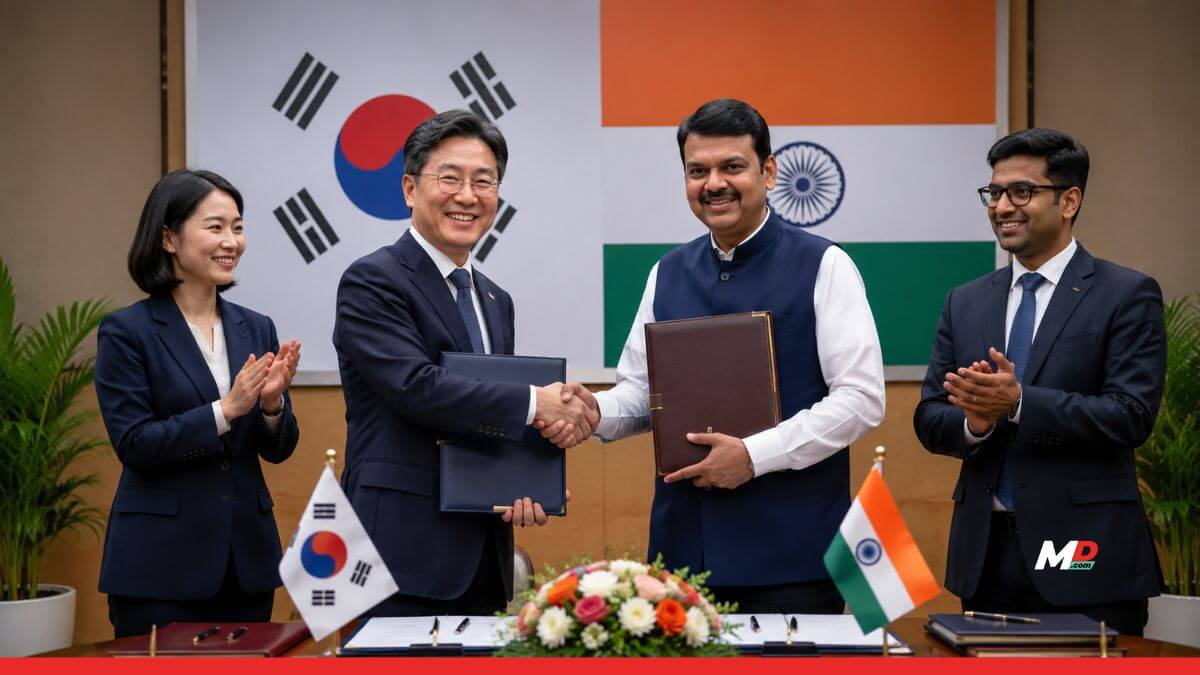
Mumbai, May 21: Maharashtra Chief Minister Devendra fadanvis on Thursday announced that Maharashtra and South Korea have entered into a major partnership aimed at strengthening skill development, technical education, innovation, and global employment opportunities for the youth of the state.
Speaking at Sahyadri Guest House in Mumbai, Chief Minister Devendra Fadnavis said South Korea has established a strong global identity in advanced industries, business, and skill development. He stated that the agreements signed between Maharashtra and South Korean institutions will bring advanced technology, modern industrial training methods, and world-class skill development expertise to India, directly benefiting students and young professionals across Maharashtra.
Three Memorandums of Understanding (MoUs) were signed under the Department of Skill Development, Employment, Entrepreneurship and Innovation in the presence of the Chief Minister. The agreements include partnerships between the Directorate of Vocational Education and Training (DVET) and Korea Polytechnics; the Maharashtra State Skill Development Society (MSSDS) and South Korea’s National Institute for Lifelong Education (NILE); and the Ratan Tata Maharashtra State Skill University (RT-MSSU) with two academic branches of the Korea Advanced Institute of Science and Technology (KAIST).
The event was attended by Maharashtra Minister for Skill Development, Employment, Entrepreneurship and Innovation mangal Prabhat Lodha Additional Chief Secretary Manisha Varma, Additional Chief Secretary to the Chief Minister Lokesh Chandra, Director of DVET Dr. Satish Suryawanshi, Vice Chancellor of RT-MSSU Dr. Apoorva Palkar, Director General of Training Dilip Kumar, Regional Director of National Skill Institute C. S. Murthy, Commissioner of Maharashtra State Innovation Society Dr. Amit Saini, and Mumbai City Collector Aanchal Goyal.
The South Korean delegation included Dr. Seung Hun Han from korea advanced institute of science and technology, Dr. Youngah Kang from Korea Polytechnics, and Ms. Min-Seon Park from the National Institute for Lifelong Education, along with senior representatives from KRIVET, KEIS, and NexIN Technology.
Chief Minister Devendra Fadnavis said India’s demographic strength, with nearly 65 percent of its population below the age of 35, gives the country a major advantage in global growth and innovation. He said the Maharashtra government is committed to transforming this youthful potential into a highly skilled and productive workforce capable of supporting national development.
Highlighting the state’s economic growth, the Chief Minister said Maharashtra’s economy currently stands at nearly USD 660 billion and is working towards becoming a USD 1 trillion economy in the near future. He said achieving this target would require highly skilled manpower at every level of the industrial ecosystem, and the international partnership with South Korea would provide strong momentum to the state’s economic expansion.
He further stated that the agreements would not remain limited to formal documentation but would soon be implemented through practical projects and institutional collaborations. According to him, the initiative will not only strengthen industries with skilled manpower but also create international employment opportunities for Indian youth.
Minister Mangal Prabhat Lodha described the agreements as a significant step toward providing Maharashtra’s youth with advanced technical training, global-level skills, and international career opportunities. He said the collaboration with leading South Korean institutions would strengthen Maharashtra’s skill ecosystem and help establish the state as a national leader in skill development, entrepreneurship, employment, and innovation.
Additional Chief Secretary Manisha Varma said the “DAKSH” initiative and support from the Korea–World Bank Partnership Facility are playing a key role in upgrading Maharashtra’s Technical and Vocational Education and Training (TVET) ecosystem to international standards. She said several reform measures are already being implemented in the state, including skill gap assessments, tracer studies of Industrial Training Institute students, and the development of model ITIs. She added that a two-day workshop being organised in Mumbai on May 21 and 22 has brought together experts from the Government of India, Government of Maharashtra, and leading South Korean skill institutions to strengthen cooperation and institutional capacity.
Learning Factory Model to be Introduced in Maharashtra
Under the agreement signed between the Directorate of Vocational Education and Training and Korea Polytechnics, Maharashtra will establish advanced training centres based on South Korea’s globally recognised “Learning Factory” model. These centres will focus on practical industry-oriented training in advanced technologies. Korea Polytechnics will act as the principal partner for the project, while institutions such as KITECH and KATECH may also participate as technical collaborators.
Officials said a strategic implementation manual for the project will be prepared between May and September 2026, while the centres are expected to become operational between March 2027 and June 2028. The training centres will provide modern industrial skill training through advanced machinery, industry-focused curricula, and specialised instructors.
Lifelong Learning Framework for Maharashtra
The agreement between the Maharashtra State Skill Development Society and South Korea’s National Institute for Lifelong Education aims to establish a comprehensive lifelong learning and skill enhancement framework for Maharashtra.The initiative will focus on digital learning systems, certification mechanisms, upskilling, and reskilling programmes to help workers and youth continuously adapt to changing industrial and technological demands. The project includes the preparation of a Lifelong Learning Policy Framework and an operational manual for the state. A digital platform for continuous skill development will also be created to bridge the gap between education and industry. The programme is expected to be implemented between January 2027 and June 2028.