
Environment
Nepal seeks ‘climate-related compensation’ from China, US, and India

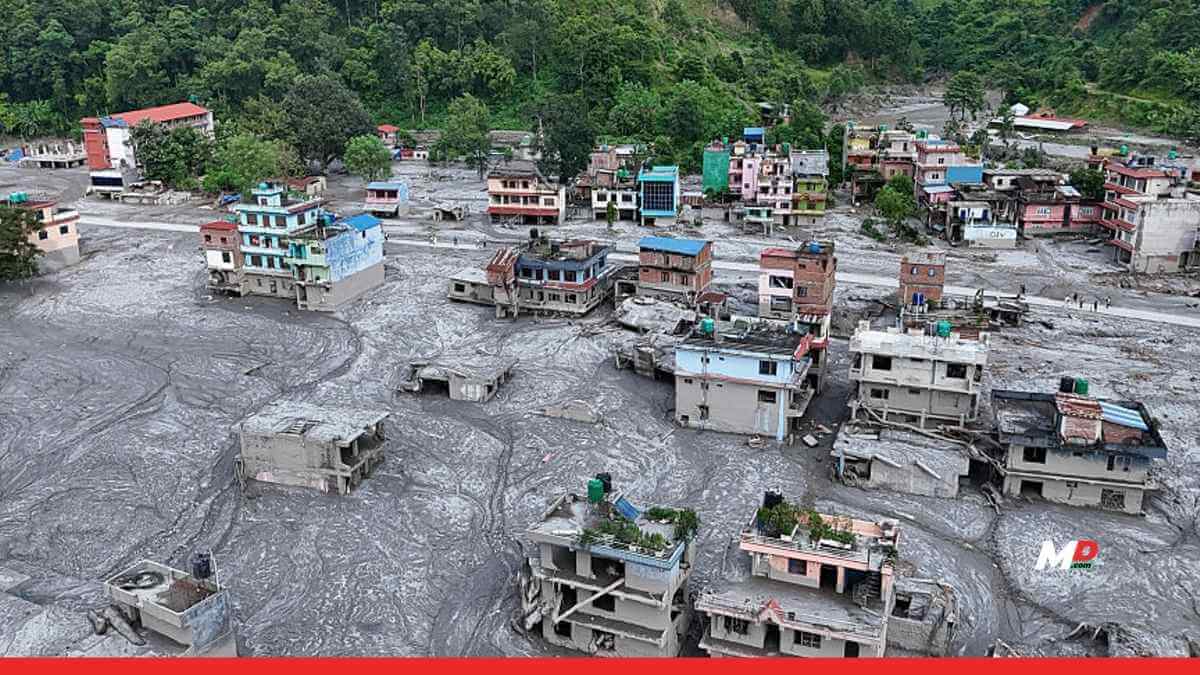
The floodwaters have begun to recede in Nepal. The question now rising in their wake is considerably harder to answer: who should pay?
Following the catastrophic flash floods that tore through the Bhotekoshi river basin on August 26, Nepal is seeking climate-related compensation from the United States, China, and India, naming them among the world’s largest greenhouse-gas emitters. More than 1,100 bodies have been recovered, while nearly 4,500 people remain missing, according to the latest reports. The disaster followed a high-altitude glacial collapse that sent a wall of ice, water, rocks, and debris down towards communities in Nepal.
Kathmandu’s argument is deliberately sharper than a conventional appeal for humanitarian assistance. Foreign Minister Shisir Khanal has said Nepal wants to move the conversation from aid to “justice and compensation”, arguing that the country is paying an enormous price for a global crisis to which it has contributed very little.
For decades, climate diplomacy has revolved around a basic inequity: countries that industrialised early built their wealth using fossil fuels, while many poorer countries are now confronting the consequences of a warming planet without having had anything close to the same carbon-intensive development journey.
Nepal sits near the sharp end of that imbalance. Its emissions are negligible in global terms, yet its geography makes it exceptionally exposed to a changing climate. The Hindu Kush Himalaya is warming, glaciers are retreating, and the consequences can travel rapidly from high-altitude ice and unstable terrain into densely populated valleys and downstream river systems.
The latest disaster offers a brutal illustration of that vulnerability. It also exposes a problem that conventional disaster relief was never designed to solve. An emergency donation can help rebuild a bridge. It can provide food, temporary shelter, or medical assistance. But what happens when extreme weather repeatedly destroys the same infrastructure, wipes out livelihoods, damages power systems, and pushes years of economic development backwards?
Nepal’s reconstruction bill could run into billions of dollars. Reuters has reported estimates of $4 billion to $5 billion, roughly 10% of the country’s GDP. The floods have also damaged a significant portion of Nepal’s hydropower capacity, forcing a country that had increasingly become an electricity exporter to turn back to imports from India.
Nepal has formally approached the UN-backed Fund for Responding to Loss and Damage, seeking urgent financial assistance. The mechanism, established at COP27 and operationalised at COP28, was created precisely because some climate impacts can no longer be addressed simply through adaptation.
Yet Nepal’s demand also raises a difficult question: where does climate responsibility end and causation begin? It would be simplistic to attribute a particular flood entirely to one country’s emissions. Extreme events have multiple causes, including geography, rainfall patterns, land use, infrastructure decisions, and local vulnerability. The legal pathway from a tonne of carbon emitted somewhere in the world to compensation for a particular village swept away in Nepal is therefore extraordinarily complicated.
There is another complication for India and China. Both are major current emitters, but both also argue that climate responsibility must account for historical emissions, per-capita emissions, development needs, and the fact that today’s wealthy economies consumed a huge share of the global carbon budget while industrialising. India, in particular, has consistently argued that developed countries should shoulder greater financial responsibility for climate action and loss and damage.
That makes Nepal’s demand politically uncomfortable for its neighbours, even as the humanitarian case for helping Nepal is difficult to dispute. Perhaps the more important question is what happens next. If the Himalayas are becoming a high-risk climate zone, compensation cannot simply mean writing cheques after every catastrophe. It has to mean financing early-warning systems, resilient roads and bridges, safer hydropower infrastructure, glacier monitoring, disaster insurance, climate-proofed settlements, and regional information-sharing.
The Himalayas do not respect national borders. Neither does climate risk. Nepal’s demand may therefore prove bigger than a request for money after one terrible flood. It could become a test of whether the world’s climate architecture can move beyond voluntary charity towards a system in which vulnerability, responsibility, resilience, and financial capacity are finally considered together.
The bill for a warming world is arriving. Nepal is asking who should pay it.