

Environment
Nepal faces fresh flood threat, as death toll crosses 900

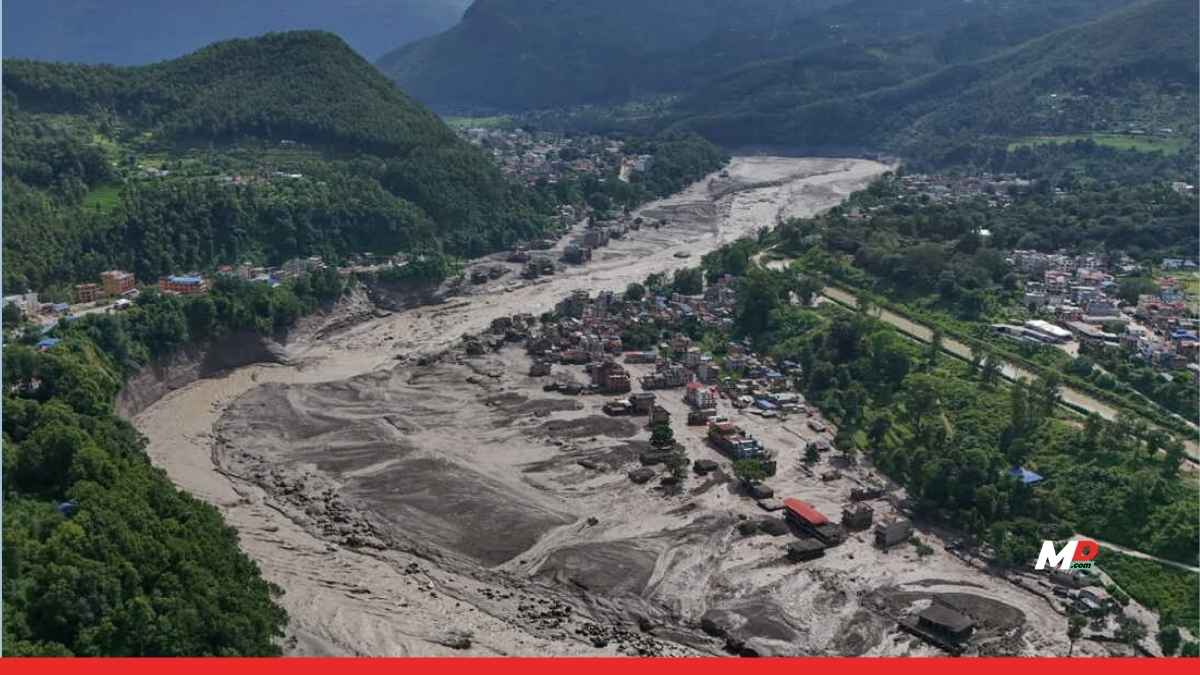
Nepal is confronting the possibility of another devastating flood even as rescue teams continue to search for thousands of people missing after last week’s catastrophic glacial collapse and flash floods.
The death toll from the disaster rose to 903 on Monday, according to Nepal’s National Disaster Risk Reduction and Management Authority, while 4,247 people remain unaccounted for. The crisis has already become one of the country’s most severe recent natural disasters, with entire communities, roads, bridges, hydropower installations, and a crucial trade corridor with China damaged or destroyed.
Now, authorities are warning that the danger has not passed.
Chinese officials alerted their Nepali counterparts to rising water flows upstream, prompting renewed warnings along the Bhotekoshi River. Kathmandu has cautioned that river levels are climbing rapidly, while further severe weather could trigger another flash flood in already devastated areas.
The immediate concern is a reminder of how unstable the Himalayan landscape has become.
Last Wednesday, an ice-and-rock collapse near the Nepal-Tibet border sent huge volumes of rock, mud, and water into river systems downstream. The resulting torrent swept through valleys with little warning, destroying homes and infrastructure and trapping people at several hydropower projects. The collapse was powerful enough to register as a magnitude 5.2 seismic event, according to reports.
On the Chinese side, a barrier lake created by the disaster has largely drained. But that has not eliminated the threat. China’s Ministry of Water Resources said an upstream crater, around 5.6 kilometres from the lake, still contained an estimated 1.4 million cubic metres of water and required continued monitoring. Several smaller water-accumulation areas also remain potential hazards.
For Nepal, meanwhile, the human toll continues to grow.
Among those still missing are 592 foreign nationals and 933 people associated with hydropower projects, according to Nepalese authorities. Nearly 10,500 people have been rescued, while more than 20,000 security personnel have been deployed for search, rescue, relief, and rehabilitation operations.
The rescue operation is being complicated by the terrain itself. Roads and bridges have been swept away, communications have been disrupted, and hundreds of people are believed to have been trapped in or around hydropower tunnels. Rescue crews are therefore relying heavily on helicopters and specialised teams to reach isolated areas.
The disaster is also becoming an international humanitarian effort. The United States and Canada have each pledged $3.6 million in assistance, while the UK has offered $6.8 million. The United Nations has released $2.5 million in emergency funding. Nepal has also sought specialised equipment, including heavy-lift drones and technologies capable of locating people trapped beneath debris.
But the immediate rescue effort could eventually become only the first chapter of a much larger challenge.
Nepal’s Foreign Minister Shisir Khanal has warned that reconstruction could cost billions of dollars. The destruction of the Bhotekoshi Corridor and the Rasuwagadhi border crossing has also disrupted one of Nepal’s key economic links with China.
More fundamentally, the disaster is forcing a difficult conversation about the vulnerability of Himalayan economies to a changing climate. Scientists have increasingly warned that warming temperatures are destabilising glaciers, ice, and rock formations at high altitude, increasing the potential for sudden and destructive events.
For Nepal, the most frightening part may be that the first catastrophe is still unfolding while the conditions for another one are already being watched upstream.
The floods devasted a nation, and Nepal is now trying to rescue its people while navigating a landscape that remains dangerously unsettled.