Business
Infosys’s €175,000 French penalty says a lot about Indian IT’s time problem


Infosys has been fined €175,000, roughly ₹2 crore, by DRIEETS Île-de-France, the labour authority for the greater Paris region, after an investigation found that the company’s system for recording employee working hours in France did not meet local legal requirements. In a stock exchange filing dated 25 July 2026, Infosys said the regulator’s objections centred on the reliability, auditability and monitoring capabilities of its time-recording system for certain categories of employees. The company also explained why it had taken time to disclose the matter to exchanges, saying it needed to verify the communication before responding.
Infosys has called the fine immaterial, and on the scale of its balance sheet, it is. The company posted a 12.2 per cent year-on-year rise in consolidated net profit for the June quarter, to ₹7,769 crore, on revenue of ₹48,211 crore. A ₹2 crore penalty barely registers as a rounding error against those numbers. But materiality to a balance sheet and materiality to the conversation around Indian IT’s working culture are two very different things, and it is worth separating them.
Work-life balance is sacrosanct
France has some of the most prescriptive working-time law in the developed world. Employers are required to maintain systems that can reliably and verifiably show how many hours an employee actually worked, precisely so that overtime, rest periods and the boundaries of the working week are not left to informal record-keeping or managerial discretion. A time-tracking system that cannot be reliably audited is not a technical footnote. It is, in effect, a system that cannot prove whether employees were made to work beyond what they were paid for, and whether they got the rest the law entitles them to. That is the substance behind the fine, whatever its size.
It would be easy, and lazy, to treat this as an isolated compliance slip by one company operating in an unfamiliar regulatory environment. It would also miss the point. Infosys has been fined for something that, at home, barely raises an eyebrow.
India’s workplace issue
ADP’s latest People at Work global workforce survey found that India now tops the world for unpaid overtime. Forty per cent of Indian employees say they put in six to fifteen unpaid hours a week, and nearly a quarter report working sixteen or more unpaid hours weekly, the highest share in the world in both bands. Globally, most workers surveyed by ADP stay within five unpaid hours a week. In India, that is closer to the exception.
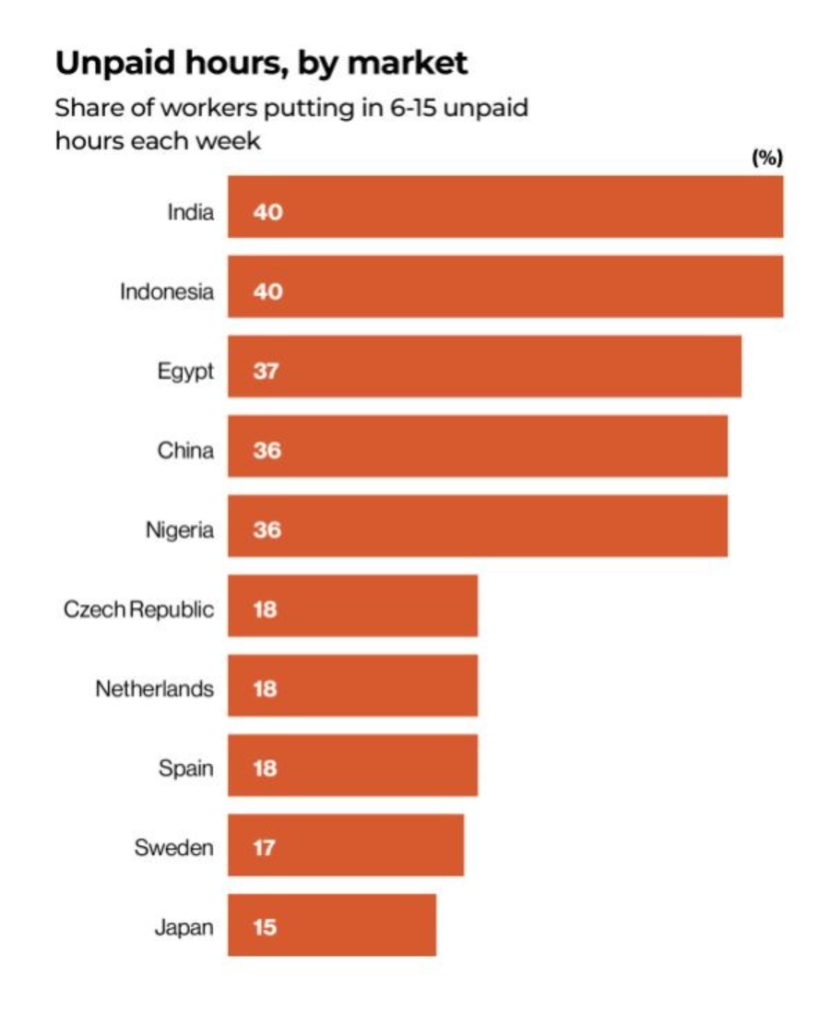
The pattern is not new. ADP’s earlier editions of the same study have repeatedly flagged India as an outlier on the Asia-Pacific unpaid overtime table, well ahead of comparable markets such as Singapore and China, in a trend that has persisted rather than eased over successive survey years.
What makes the Indian data more uncomfortable, not less, is a companion finding from ADP’s own research: Indian employees report among the highest levels of satisfaction with their pay of any market surveyed, with only a small minority saying they feel underpaid.
Put those two findings side by side and a fairly stark cultural picture emerges. Indian professionals are not simply being overworked. Many of them have been conditioned to regard extreme unpaid overtime as normal, even unremarkable, to the point where it does not register as a grievance worth naming when someone asks whether they feel fairly compensated. That is a harder problem than a bad time-tracking tool. Software can be patched. A workplace culture that has internalised unpaid overtime as a mark of commitment rather than a labour rights issue is not fixed by an audit.
Overtime, across the board
ADP’s data also points to where this bites hardest: seniority, not entry-level grind, is the strongest predictor of unpaid hours. Half of senior leaders and upper managers report at least six unpaid hours a week, and one in five C-suite executives report sixteen or more. The popular image of the overworked fresher pulling all-nighters is only half the picture. The higher up the ladder, the more unpaid time is quietly absorbed, and the less likely anyone is to call it what it is.
None of this makes the French fine a smoking gun for anything beyond a specific compliance failure in a specific jurisdiction, and Infosys is far from the only global company to have had a working-time system fall foul of European regulators. But the fine is a useful mirror. It exists because France has built regulatory machinery specifically designed to make unpaid, unrecorded overtime visible and costly. India, by and large, has not, and the ADP numbers suggest the absence of that machinery is not incidental to the outcome.
Infosys will pay its ₹2 crore, note it as immaterial, and move on, as it should, given the numbers involved. The more useful question for India’s IT sector and its wider white-collar workforce is not why a French regulator caught this once, but why nothing comparable exists to catch it, routinely, at home.