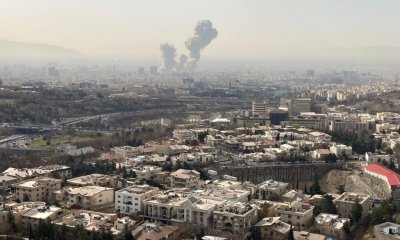
Iranian state media confirmed the death of Supreme Leader Ayatollah Ali Khamenei in a joint United States and Israeli military strike, an event that plunges the Islamic Republic into a severe succession crisis. In the light of this, Iran promises fierce retaliatory measures against Israeli territory and American regional military installations across the Gulf in the wake of the bombardment, as diplomatic negotiations collapse thanks to Israel-US aggression.
The geopolitical architecture of the Middle East has been fundamentally fractured. Following hours of intense speculation, Iranian state media officially confirmed on Sunday that Supreme Leader Ayatollah Ali Khamenei was killedv in a massive joint military operation conducted by the United States and Israel. The targeted aerial bombardment of his secure compound in downtown Tehran eliminates the spiritual and political linchpin who has steered the Islamic Republic for more than three decades. At eighty-six years old, his sudden removal creates an immediate and dangerous leadership vacuum in a nation already grappling with severe internal dissent and profound economic pressures.
Also read: USA and Israel attack Iran, plunging Middle East into chaos
United States President Donald Trump announced the successful operation before Tehran offered its official confirmation. The president characterized the assassination as the greatest chance for the Iranian people to take back their country, adding that heavy and pinpoint bombing operations will continue.
At the United Nations, American and Israeli envoys defended their acts of aggression as a lawful necessity to prevent Iran from acquiring a nuclear weapon, dismissing Iranian protests. The joint operation represents a startling escalation in risk tolerance from Washington, discarding previous guardrails that protected the supreme leader to avoid a wider regional conflagration.
Schoolchildren killed in Israeli-US attack
However, the military campaign has exacted a catastrophic civilian toll that threatens to isolate the allied forces internationally. Iranian officials report that a joint strike by the Israeli and US forces hit the Shajareh Tayyebeh girls elementary school in the southern city of Minab. The bombardment occurred just as parents were dropping their children off for morning classes. Health ministry officials state that more than one hundred children were killed in the blast, with dozens more trapped beneath the burning rubble. Footage from the site showed chaotic scenes of devastated parents and severe structural ruin next to a Revolutionary Guards facility.
The civilian casualties have sparked immediate global outrage and shifted the diplomatic narrative. During an emergency meeting of the United Nations Security Council, Iranian diplomats denounced the school bombing as a blatant war crime. They highlighted the hypocrisy of nations that condemn retaliation while ignoring the deaths of innocent schoolchildren.
Across Iran, the reaction is deeply polarized. While some citizens who opposed the current government quietly celebrated the strike on leadership compounds, the mass casualty event in Minab has tempered any relief with profound grief and fear of further collateral damage.
Tehran promises ‘no leniency’
Tehran has wasted no time in executing its promised reprisals. The Islamic Revolutionary Guards Corps announced the initiation of a devastating offensive operation targeting Israeli territories and American terrorist bases across the region. Iran has launched a barrage of ballistic missiles and explosive drones at several key installations, including the al-Udeid airbase in Qatar, the Ali al-Salem base in Kuwait, and the United States Fifth Fleet base in Bahrain.
An Israeli emergency service confirmed casualties in the Tel Aviv area following a direct missile impact. The Iranian military warned regional neighbors that any state facilitating allied operations will be treated as a legitimate target without leniency.
Domestically, the Iranian government is mobilizing to maintain civil order and project continuity amid the chaos. Authorities have declared a forty-day period of public mourning and a seven-day nationwide holiday to commemorate Khamenei. Flags have been lowered to half-mast, and mourning ceremonies are being organized at major pilgrimage sites. The supreme national security council has urged citizens to remain united against foreign aggression, assuring the public that essential goods, fuel, and medical supplies remain abundantly available. Yet, behind this facade of stability, a brutal power struggle is likely unfolding within the political elite.
Life after Khamenei
The mechanism for replacing the supreme leader is fraught with uncertainty. Officially, an assembly of experts consisting of hardline clerics is tasked with selecting a successor. However, the unprecedented nature of Khamenei being killed in office, coupled with the deaths of several other senior officials in the strikes, leaves no clear heir apparent.
The Islamic Revolutionary Guards Corps, which has amassed vast economic and military power over the decades, is expected to play a dominant role in the transition. Analysts suggest the paramilitary organization may seize outright operational control of the country to prevent the civilian government from conceding to Western pressure. The region now stands on the precipice of a protracted war of attrition. The joint United States and Israeli strikes have obliterated any remaining hopes for a diplomatic resolution regarding the Iranian nuclear program.
As retaliation begets retaliation, the conflict threatens to choke crucial global energy transit routes, including the Strait of Hormuz. The international community faces the grim reality of a fully destabilized Middle East, where the removal of a paramount leader has not brought swift capitulation, but rather unleashed a volatile chain reaction of violence that will reshape global security dynamics for a generation.