

Lifestyle
Marriage Is No Longer a Deadline: Why More Indian Women Are Redefining What a Fulfilling Life Looks Like


From financial independence and career ambitions to changing relationship expectations, a generational shift is challenging India’s traditional marriage narrative. But is the country witnessing a rise in women rejecting marriage, or simply a growing acceptance of having a choice?
For generations, marriage in India was more than a personal milestone. It was a social expectation, a family responsibility and, for many women, an almost inevitable next chapter after education.
That narrative is beginning to change.
Across India’s metropolitan cities and increasingly its smaller urban centres, conversations around marriage are evolving. More women are prioritising financial security, professional ambitions, personal independence and emotional compatibility before making decisions about long-term relationships.
For some, this means postponing marriage. For others, it means being considerably more selective about their partners. And for a growing section, remaining unmarried is no longer viewed as an undesirable outcome.
The shift is not necessarily about rejecting marriage as an institution. It is about challenging the assumption that marriage must be the ultimate measure of a woman’s personal success.
And the numbers offer some interesting clues about this changing social landscape.
The Numbers Behind India’s Changing Marriage Landscape
India’s demographic transition provides an important starting point.
According to the Ministry of Statistics and Programme Implementation’s Youth in India 2022 report, the proportion of women aged 15–29 who had never married increased from 13.5% in 2011 to 19.9% in 2019.
The increase suggests that marriage is taking place later for a growing section of young women. However, it does not establish how many intend to remain unmarried permanently.
The Sample Registration System’s Statistical Report for 2022 puts the mean age at effective marriage for Indian women at 22.7 years, compared with 21.2 years in 2011. The urban average stood at 23.9 years, against 22.2 years in rural India.
This urban-rural difference is particularly revealing. Education, employment opportunities, migration and changing family structures are all influencing when women choose to marry.
India’s latest National Family Health Survey, NFHS-6 (2023–24), provides further evidence of the country’s changing social and demographic profile.
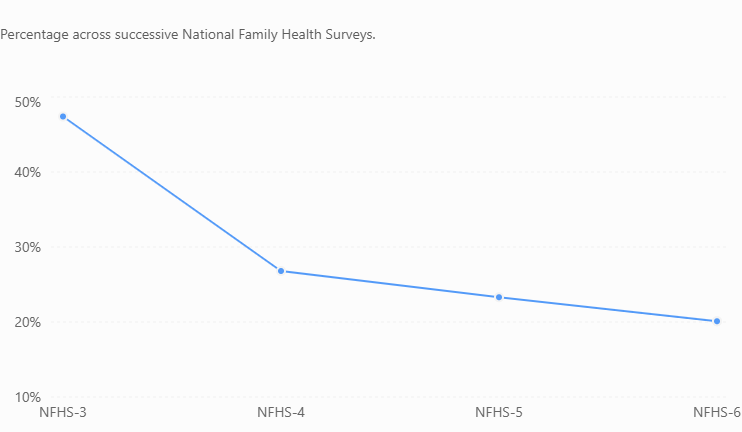
Among women aged 20–24, the proportion married before the age of 18 declined to 20.1%, compared with 47.4% in NFHS-3 (2005–06).
The country’s total fertility rate also remained at 2.0 children per woman, indicating a broader demographic transition.
Taken together, these indicators point towards delayed marriage, changing reproductive choices and a gradual transformation of family structures.
Financial Independence Is Changing the Equation
Perhaps the biggest catalyst behind changing attitudes towards marriage is economic independence.
For decades, financial security was closely associated with marriage for many Indian women. Today, access to education, professional opportunities, entrepreneurship and financial services is gradually changing that relationship.
According to the Periodic Labour Force Survey (PLFS) 2023–24, India’s female labour force participation rate for women aged 15 and above reached 41.7%, compared with 23.3% in 2017–18.
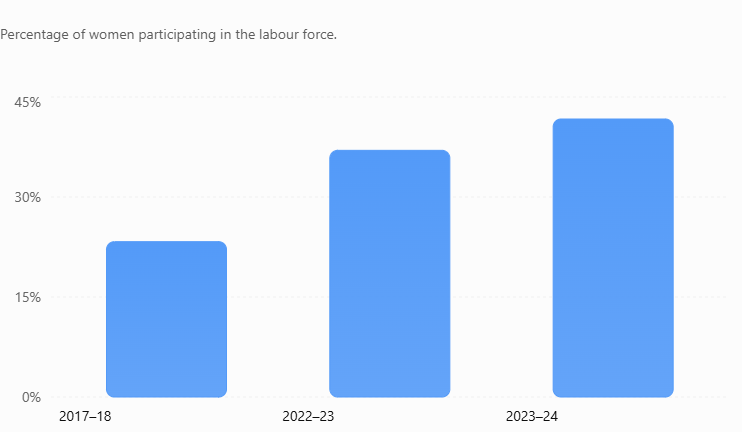
While participation in the workforce does not automatically translate into financial independence for every woman, it reflects a significant shift in women’s economic engagement.
NFHS-6 also reports that 61.5% of women aged 15–49 have completed at least 10 years of schooling.
With greater access to education and employment, marriage is increasingly becoming a personal decision rather than an economic necessity.
For an independent professional, the question is no longer simply whether marriage offers financial or social security. It is whether the relationship contributes meaningfully to the life she has already built.
The Changing Expectations From Relationships
Financial independence is only one part of the story. Expectations from relationships are evolving just as rapidly.
A 2025 study published in the Journal of Family Issues, titled ‘Marriage is a Complete Gamble: Marriage Attitudes of the Indian Middle Class’, examined interviews with 40 young, middle-class Indians.
The research found that young adults often approach marriage pragmatically, weighing compatibility, uncertainty, social expectations and the potential consequences of their decisions.
Interestingly, arranged marriages continue to appeal to many because parental involvement can provide a support system. At the same time, some participants preferred choosing their own partners despite the social and personal uncertainties involved.
This reflects an interesting contradiction in contemporary India: traditional marriage structures continue to hold relevance, but individuals increasingly want greater control over the decisions within them.
For many women, emotional compatibility, mutual respect, shared responsibilities and personal space are becoming important considerations.
The willingness to compromise simply to meet a socially prescribed marriage deadline appears to be giving way to a more deliberate approach.
The Cost of Marriage Is Also Being Reconsidered
Marriage is not merely an emotional commitment. It often involves significant financial, professional and lifestyle adjustments.
Wedding expenses, housing decisions, relocation, childcare responsibilities and expectations from extended families can influence how couples approach the institution.
For women pursuing demanding careers, the prospect of balancing professional ambitions with unequal domestic responsibilities can become a serious consideration.
The issue is not necessarily marriage itself, but the possibility of entering a partnership in which personal aspirations and responsibilities are not equally respected.
The expectation that women will automatically adjust their careers, relocate or assume a disproportionate share of household responsibilities is increasingly being questioned.
For some, choosing to remain single may therefore represent a preference for retaining control over their time, finances and lifestyle.
Is India Becoming More Accepting of Singlehood?
Despite these changes, India remains a society where marriage carries considerable cultural significance.
Family expectations, community perceptions and concerns about social acceptance continue to influence individual decisions.
A woman choosing to remain unmarried may still face questions about her future, family responsibilities and long-term companionship.
A 2025 ethnographic study published in the Journal of Marital and Family Therapy, examining singlehood in urban India, highlights how gender, age, class and family expectations shape the experiences of single women.
The research also explores how friendships, support networks and alternative family structures can become important sources of belonging and companionship.
This is an important distinction: remaining unmarried does not necessarily mean choosing isolation.
Many women are building meaningful lives around careers, friendships, travel, family connections and personal interests, without necessarily viewing marriage as a prerequisite for fulfilment.
However, challenges around social support, ageing, financial planning and access to care remain relevant, particularly in a society where many support systems are traditionally organised around families.
The Indian Marriage Institution Is Evolving, Not Disappearing
It would be premature to conclude that Indian women are abandoning marriage.
Arranged marriages remain an important part of India’s social fabric. Dating, relationships, marriage and family-building continue to be significant aspirations for millions.
What appears to be changing is the relationship between individual choice and social expectation.
Women are increasingly evaluating marriage on their own terms, rather than treating it as an unavoidable stage of adulthood.
For some, that means marrying later. For others, it means finding a partner who shares their ambitions and values. And for some, it means building a fulfilling life without marriage altogether.
The larger story is therefore not about a decline in the relevance of marriage, but about the changing definition of what makes a life successful.
As India’s workforce, education system and urban society continue to evolve, the institution of marriage will inevitably evolve with them.
Perhaps the most significant shift is this: marriage is increasingly becoming a choice to be made, rather than a deadline to be met.
