

Business
I Can Answer You, But Stop Yelling’: Indian-Origin Tech Veteran Jay Puri’s Reported Clash With Jensen Huang’s Daughter

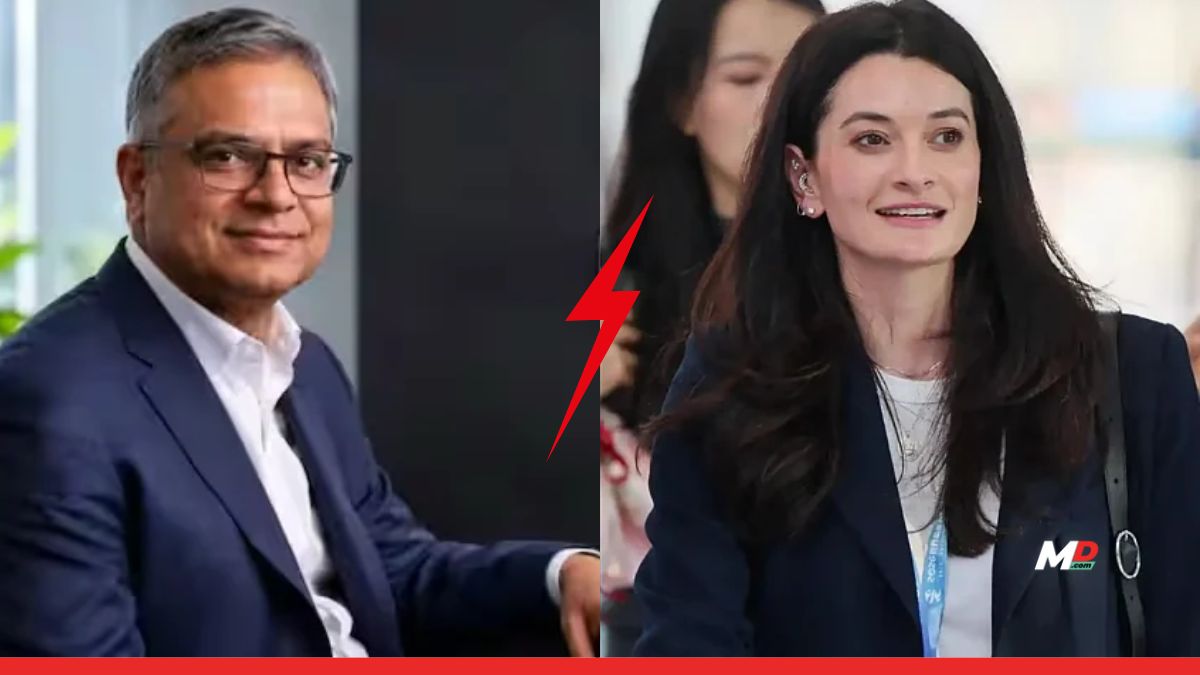
A tense exchange ahead of the India AI Summit has brought renewed attention to Jay Puri’s two-decade journey at Nvidia, Madison Huang’s reported influence within the company, and the difficult intersection of family influence and corporate leadership.
An unexpected confrontation inside one of the world’s most powerful technology companies has put Indian-origin executive Jay Puri in the spotlight.
Puri, a veteran business leader who spent more than two decades at Nvidia, reportedly found himself at the centre of a heated exchange with Madison Huang, daughter of Nvidia co-founder Jensen Huang, during preparations for the India AI Summit in New Delhi earlier this year.
The incident, first detailed in a report by The New York Times, reportedly unfolded after Jensen Huang withdrew from his scheduled appearance at the event at the last minute and asked Puri to represent him instead.
The change in plans appears to have triggered considerable frustration within the company’s leadership team. With arrangements for the conference still being finalised, Madison Huang reportedly confronted senior executives during a conference call, questioning their preparedness and the state of the event’s planning.
The discussion eventually escalated to a point where Puri intervened.
According to people familiar with the exchange, Puri told Madison Huang: “I can answer your questions if you stop yelling at me.”
The response was striking, particularly given the organisational dynamics involved and Puri’s longstanding association with the company’s leadership.
Who Is Jay Puri? The Indian-Origin Executive Behind Nvidia’s Global Expansion
While the confrontation has attracted attention, Puri’s professional journey is equally noteworthy.
Ajay K. Puri, popularly known as Jay Puri, joined Nvidia in 2005 after spending approximately 22 years at Sun Microsystems. Over the years, he became one of the company’s most influential business executives, overseeing its worldwide operations.
His responsibilities spanned global sales, business development, strategic partnerships, solution architecture, engineering, programme management and customer support.
Before Nvidia, Puri also held positions at Hewlett-Packard, Booz Allen & Hamilton and Texas Instruments.
His academic credentials include an undergraduate degree in electrical engineering from the University of Minnesota, a master’s degree in electrical engineering from the California Institute of Technology and an MBA from Harvard Business School.
His departure from Nvidia, reportedly within six months of the February confrontation, marked the end of a career spanning more than two decades at the chipmaker. He had transitioned towards an advisory role before his exit, according to subsequent media reports.
Madison Huang And The Question Of Influence
The incident has also brought attention to Madison Huang’s reported influence within Nvidia.
Although her formal responsibilities were associated with product marketing, The New York Times, citing interviews with more than a dozen current and former employees, described her as having assumed a considerably wider role within the organisation.
She reportedly became a close adviser to her father, participating in important discussions and exercising influence over aspects of marketing, communications and business decisions.
The report also described tensions between Madison and several senior executives, with employees raising concerns about her management style and interactions within the company.
These accounts, however, are based on sources interviewed by the publication and should be understood as reported allegations rather than independently established findings.
The Bigger Leadership Lesson
Beyond the personalities involved, the episode raises an important question for organisations operating at the highest levels of business: where does authority end and accountability begin?
As companies scale into global powerhouses, their leadership structures inevitably become more complex. Founders, family members, professional executives and board-level stakeholders can all wield varying degrees of influence.
But organisational influence must ultimately be accompanied by accountability.
Experience, professional standing and organisational hierarchy should not become irrelevant simply because someone has a direct relationship with the founder or the chief executive.
Equally, high-performance cultures cannot be built on intimidation or the normalisation of aggressive communication. Disagreement, scrutiny and demanding performance standards are integral to business. Respect, however, must remain non-negotiable.
For Jay Puri, the reported exchange may have lasted only a few moments on a conference call. But it has since become a larger conversation about professional dignity, leadership conduct and the dynamics of power inside global corporations.
And perhaps that is the most enduring takeaway: strong leadership is not just about having the authority to ask difficult questions. It is also about having the discipline to listen to the answers.