

Business
“Nifty 29,000: Is India’s Next Bull Run Finally Here?”


JPMorgan sees a potential 12% upside for Indian equities by the end of 2027, driven by stronger corporate earnings, returning foreign capital and India’s growing appeal as an alternative to crowded AI-heavy markets. But with valuations still demanding and global uncertainties persisting, should investors start buying, hold their positions or wait for a correction?
After months of uncertainty, foreign investor selling and a prolonged period of underperformance, India’s stock market appears to be finding its footing again.
And one of the world’s most influential investment banks is becoming increasingly optimistic about what comes next.
JPMorgan has assigned the Nifty 50 a base-case target of 29,000 by December 2027, implying an upside of approximately 12% from its November 26 closing level of 25,884.50.
The brokerage has also outlined a bull-case scenario of 31,000 and a bear-case scenario of 22,000, underlining how significantly the eventual outcome could depend on corporate earnings, valuations and global capital flows.
The forecast comes after what JPMorgan has described as the ‘great comeback of 2026’.
The Nifty had experienced a correction of more than 15% earlier in the year before staging a substantial recovery. Despite the rebound, the index was still on track for its first annual decline in 11 years.
So, what has changed?
More importantly, is this the beginning of India’s next sustained equity rally, and how should investors position their portfolios?
1. India Is Emerging as an Alternative to the Global AI Investment Trade
One of the more interesting aspects of JPMorgan’s latest outlook is its argument that India could benefit from investors diversifying away from increasingly concentrated AI-related investments.
Over the past year, global capital has gravitated towards semiconductor manufacturers, artificial intelligence infrastructure companies and technology-heavy markets, particularly in parts of East Asia.
Markets such as South Korea and Taiwan have attracted considerable attention because of their exposure to the global AI supply chain.
However, rising valuations and volatility in AI-linked stocks have prompted investors to reconsider the concentration of their portfolios.
JPMorgan believes India could emerge as an attractive alternative.
Unlike markets whose performance is heavily influenced by semiconductor exports and AI hardware demand, India’s equity market has a broader domestic economic foundation.
Banking, consumption, infrastructure, healthcare, industrials and financial services represent significant components of its listed corporate ecosystem.
The brokerage’s argument is not that India will outperform every AI-focused market. Rather, it offers global investors a different growth opportunity and a way to diversify their exposure.
For India, this could become an important source of foreign investment over the next few quarters.
2. Corporate Earnings Could Become the Next Market Catalyst
A sustained stock-market rally ultimately needs something more substantial than optimism.
It needs earnings growth.
JPMorgan expects MSCI India earnings to grow by 12% in calendar 2026, accelerating to 14% in 2027.
Several factors are expected to support this improvement.
Resilient consumption: India’s domestic consumption remains an important driver of corporate revenue, supported by household demand and improving economic activity.
Stronger profitability: Better operating efficiencies and potentially lower input costs could support corporate margins.
Credit growth: Financial institutions could benefit from expanding credit demand, particularly if economic activity and private investment strengthen.
Private capital expenditure: Companies are increasingly investing in manufacturing, infrastructure and industrial capacity, potentially creating another source of earnings growth.
The important point is that JPMorgan’s 29,000 target is largely an earnings-driven forecast rather than a prediction of another dramatic expansion in stock-market valuations.
In a November 27 interaction with NDTV Profit, JPMorgan’s head of India equity research, Sanjay Mookim, reiterated that the forecast assumes approximately 13–14% earnings growth, with valuation multiples remaining broadly unchanged.
For investors, this is a more meaningful signal than simply hearing that a global brokerage expects the market to rise.
It suggests that the next phase of returns will increasingly depend on whether companies deliver on their earnings expectations.
3. Could $100 Billion in Foreign Capital Return to India?
Perhaps the biggest potential catalyst in JPMorgan’s assessment is the possibility of a substantial return of foreign institutional investment.
Foreign portfolio investors have been relatively cautious about Indian equities, with valuations, global opportunities and currency considerations influencing their allocation decisions.
However, JPMorgan believes India could attract approximately $100 billion in net foreign inflows if global long-only investors bring their Indian equity exposure back to benchmark weights.
India accounts for approximately 15% of the MSCI Emerging Markets index.
If global, emerging-market and regional funds gradually restore their exposure in line with benchmark allocations, the potential capital movement could be substantial.
There are already signs of a change in sentiment.
Foreign investors recorded approximately $13.8 billion in net equity purchases during November up to the latest reported period, following substantial selling earlier in 2026.
The improvement in sentiment has coincided with a recovery in Indian equities, easing oil prices and a reassessment of global investment opportunities.
However, the $100 billion figure represents a potential scenario rather than a guaranteed inflow.
Foreign investors remain sensitive to valuations, global interest rates, currency movements and relative returns across markets.
Nevertheless, even a partial return of foreign capital could provide meaningful support to India’s large-cap stocks.
What Does JPMorgan Actually Expect From the Nifty?
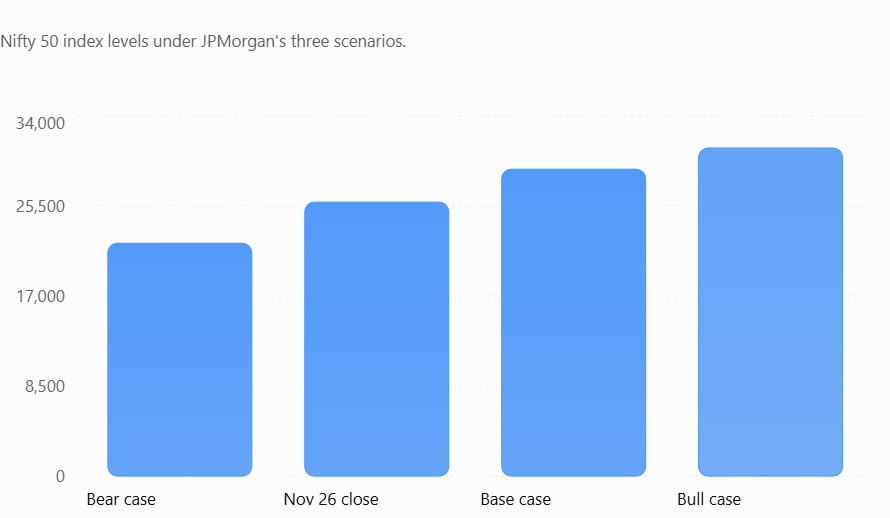
The brokerage’s three scenarios offer a useful way to understand the opportunity and the risks.
| Scenario | Nifty target by end-2027 |
| Bull case | 31,000 |
| Base case | 29,000 |
| Bear case | 22,000 |
The base case implies approximately 12% upside from the November 26 closing level.
The bull case assumes stronger earnings delivery and a more favourable valuation environment.
The bear case reflects slower earnings growth and a more pronounced valuation contraction.
The range is important because it demonstrates that even a bullish long-term outlook does not eliminate the possibility of meaningful market losses.
Investors should therefore avoid treating 29,000 as a guaranteed destination.
Which Sectors Could Benefit Most?
JPMorgan is expressing a preference for domestically oriented businesses over export-dependent sectors.
Its preferred sectors include:
Financials: Banks and financial services companies could benefit from credit expansion, stronger economic activity and improving earnings.
Industrials: Infrastructure development, manufacturing investment and private capital expenditure could create opportunities for industrial businesses.
Healthcare: Pharmaceutical and healthcare companies offer exposure to domestic demand and global healthcare spending.
Consumer discretionary: Rising household incomes and improving consumption could support businesses across automobiles, retail and lifestyle categories.
The brokerage has also maintained an underweight position on information technology and downgraded materials, particularly metals and mining.
The reasoning is that the next phase of India’s growth could be driven more by domestic demand, investment and earnings visibility than by global commodity cycles or technology exports.
For investors, this reinforces the importance of sector selection rather than buying the entire market indiscriminately.
The Risks Investors Should Not Ignore
A bullish forecast from a global brokerage should never be interpreted without examining the assumptions behind it.
There are several factors that could disrupt JPMorgan’s outlook.
1. Elevated valuations
Indian equities continue to command a premium relative to several emerging markets. If earnings growth fails to meet expectations, valuations could contract.
2. Higher interest rates
JPMorgan expects the Reserve Bank of India to raise interest rates by 25 basis points at each of its next three meetings. Higher borrowing costs could affect credit demand, corporate profitability and equity valuations.
3. Inflation and rural demand
Weak monsoon conditions and El Niño-related risks could put pressure on food inflation and rural consumption.
4. Global geopolitical uncertainty
International conflicts, changes in trade policy and global financial-market volatility could affect foreign investment flows.
5. Earnings disappointments
The market may already be pricing in an improvement in corporate profitability. Companies that fail to deliver could face sharp corrections, particularly where valuations are demanding.
The broader message is that India’s economic story remains attractive, but equity-market returns will depend on the price investors pay and the earnings businesses eventually deliver.
What Should Indian Investors Do Now?
For retail investors, the immediate temptation may be to increase equity exposure aggressively in anticipation of the Nifty reaching 29,000.
That may not necessarily be the smartest approach.
A more disciplined strategy would focus on participating in the potential upside while retaining the ability to withstand volatility.
Here are five considerations worth keeping in mind.
1. Avoid Chasing the Rally
If you have missed the recent market recovery, resist the temptation to deploy a large amount of money simply because global brokerages have turned bullish.
Market forecasts are based on assumptions, and prices can move sharply in either direction.
Investors with long-term horizons may consider staggered entry rather than attempting to identify the perfect market level.
2. Give Greater Attention to Earnings Quality
The next phase of market performance could reward companies that consistently deliver revenue growth, healthy cash flows, sustainable margins and manageable debt.
Investors should examine quarterly results and earnings revisions rather than relying entirely on management commentary or popular market narratives.
3. Review Your Large-Cap Exposure
If the expected return of foreign capital materialises, larger, liquid companies could be among the beneficiaries.
Investors may want to review their exposure to quality large-cap businesses, particularly in financials, industrials and healthcare.
However, a large market capitalisation alone does not make a stock attractively valued.
4. Be Selective With Mid-Caps and Small-Caps
The possibility of a broader economic recovery may create opportunities beyond the Nifty 50.
However, smaller companies can be more vulnerable to valuation corrections, liquidity constraints and earnings disappointments.
Investors should pay particular attention to balance sheets, cash-flow generation, promoter conduct and the sustainability of growth.
5. Maintain Diversification and Liquidity
A portfolio should not be built around a single market forecast.
Equity exposure should be balanced against debt investments, liquid reserves and other suitable asset classes depending on individual financial objectives and risk tolerance.
For long-term investors, disciplined SIPs in diversified equity funds may be preferable to making large allocation changes based on short-term market calls.
Investors approaching major financial commitments should also avoid exposing money needed in the near term to equity-market volatility.
The Bigger Picture: India’s Growth Story Is Becoming an Earnings Story
For several years, India’s equity-market narrative has been built around its long-term economic potential, demographic advantages, infrastructure expansion and consumption opportunity.
These remain important structural drivers.
But markets eventually demand evidence that economic growth is translating into corporate profitability.
JPMorgan’s latest forecast suggests that investors may increasingly reward companies capable of converting India’s growth opportunity into measurable earnings.
The possible return of foreign capital could add another layer of support, while India’s relative attractiveness as a diversification destination may strengthen its position among global investors.
Yet the journey will not necessarily be linear.
Interest rates, inflation, geopolitics and valuations will continue to influence the direction of the market.
For investors, the opportunity lies in recognising the underlying trend without becoming overconfident about the destination.
The Nifty at 29,000 is an interesting forecast. But the real investment opportunity will belong to those who identify businesses capable of growing their earnings, generating cash and creating shareholder value – regardless of where the index stands.