
Business
Remarkable U-Turn: N Chandrasekaran reappointed as Chairman of Tata Group

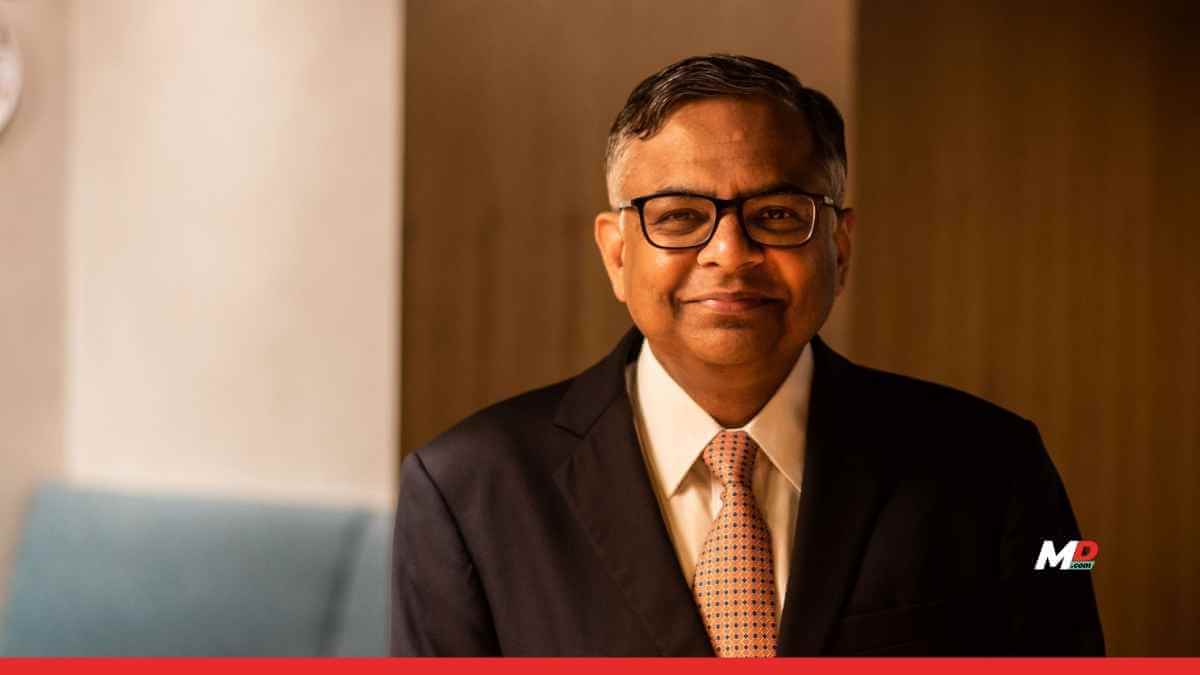
There is a rather large plot twist unfolding inside the Tata Group. N Chandrasekaran, who had told the Tata Sons board in August that he would not seek another term as chairman, is now set to remain at the helm for another five years. The Tata Sons board has approved his reappointment, reversing a decision that had appeared to set the group on a succession path.
The twist, however, is unlikely to end the drama. Tata Trusts chairman Noel Tata is reported to oppose Chandrasekaran’s reappointment and is expected to challenge the decision. Since Tata Trusts collectively own about 66% of Tata Sons, the board’s decision still faces an important test at the shareholder level. Another Tata Trusts nominee, Venu Srinivasan, has reportedly supported the board’s decision, underscoring that the Trusts themselves are not necessarily speaking with one voice.
That makes the apparent U-turn less a straightforward leadership extension and more a sign of a deeper contest over the future architecture of the Tata Group.
The timing is the real story
Chandrasekaran’s reversal comes at precisely the moment when Tata Sons is confronting one of the biggest structural decisions in its recent history: whether, and how, it becomes a publicly listed company.
The Reserve Bank of India has rejected Tata Sons’ request to surrender its registration as a core investment company. That effectively leaves the group facing the regulatory requirement to list Tata Sons, unless its legal challenge to the RBI position succeeds. The RBI’s decision has already revived market expectations of a Tata Sons listing, with shares of several Tata companies rising sharply on the possibility of value unlocking.
The listing question is much bigger than an IPO. Tata Sons is the holding company at the centre of the group, with stakes in dozens of Tata businesses. As a private company, its ownership and governance structure have historically operated with a degree of insulation from public markets. A listing would introduce a different level of disclosure, scrutiny, valuation pressure, and shareholder accountability. It could also materially alter the dynamics between Tata Trusts, other shareholders and the professional management of the group.
That is why the current disagreement over Chandrasekaran’s tenure cannot be neatly separated from the listing debate.
A succession question became a governance question
Chandrasekaran’s decision in August not to seek another term had appeared to create a relatively clean succession problem. Reports began circulating around possible internal and external candidates, while the group confronted the practical difficulty of forming the mechanisms needed to select a successor.
But the succession process has been complicated by governance issues within the Tata Trust structure itself. The Sir Ratan Tata Trust has faced restrictions affecting its ability to participate in certain governance processes, contributing to delays around Tata Sons’ annual general meeting and succession planning.
Against that backdrop, retaining an incumbent suddenly becomes considerably more attractive from a continuity perspective, particularly when Tata Sons is simultaneously dealing with regulatory uncertainty and the prospect of a listing.
There is also the question of Chandrasekaran’s record and the strategic trajectory of the group. Since taking over in 2017, he has presided over a period in which Tata expanded aggressively across technology, electronics, aviation, electric vehicles and other new businesses. Tata’s acquisition of Air India and its subsequent consolidation of aviation assets, the semiconductor push, and large investments in new businesses have increased both the strategic ambition and capital requirements of the group.
A public Tata Sons could provide a different capital-market framework for that next phase. Some Tata Trusts trustees have publicly argued that a listing could improve transparency and provide capital for new businesses, including semiconductors. Others, including Noel Tata, have opposed the idea of taking Tata Sons public.
The shareholder arithmetic matters
The ownership structure makes the coming battle particularly important. Tata Trusts hold roughly two-thirds of Tata Sons, while the Shapoorji Pallonji Group owns 18.37%. Tata Group companies hold much of the remaining stake. That means a board-level decision does not automatically settle the question.
The situation is further complicated by the fact that the interests of the various stakeholders do not appear perfectly aligned. The Shapoorji Pallonji Group, for instance, has historically had a significant financial interest in its Tata Sons stake, and recent reporting has linked its position to the implications of a potential listing.
So the battle is no longer simply about whether Chandrasekaran stays. It is about who gets to define the next version of Tata Sons.
Why the five-year extension matters
The length of the proposed extension is significant. A five-year term would take Chandrasekaran well into the next phase of Tata Sons’ transformation, potentially encompassing the group’s response to the RBI’s listing requirements and the transition to life as a publicly scrutinised holding company. That makes the chairman’s position strategically important to the listing process itself.
The irony is hard to miss. Chandrasekaran’s earlier decision to leave appeared to resolve one problem by triggering a succession exercise. His return may solve the immediate continuity problem while intensifying the underlying governance dispute.
And the disagreement now has a very different backdrop from the one that existed when he first became chairman in 2017. Ratan Tata‘s death changed the emotional centre of the group.
The RBI has challenged the structural status quo around Tata Sons. Tata Trusts is negotiating its role in a more complex corporate environment. And a potential public listing could bring the holding company into a much more transparent, market-driven world.
The Tata Group has spent decades cultivating an unusual corporate model in which ownership, philanthropy and professional management coexist under one umbrella. The current tussle is testing how that model works when its stakeholders disagree.
Chandrasekaran’s U-turn may therefore be remembered less as a story about one chairman changing his mind and more as the moment when the unresolved question of who controls the future direction of Tata Sons moved firmly into the open.