

Government
“Central Banks Are Buying Gold. Should You?”

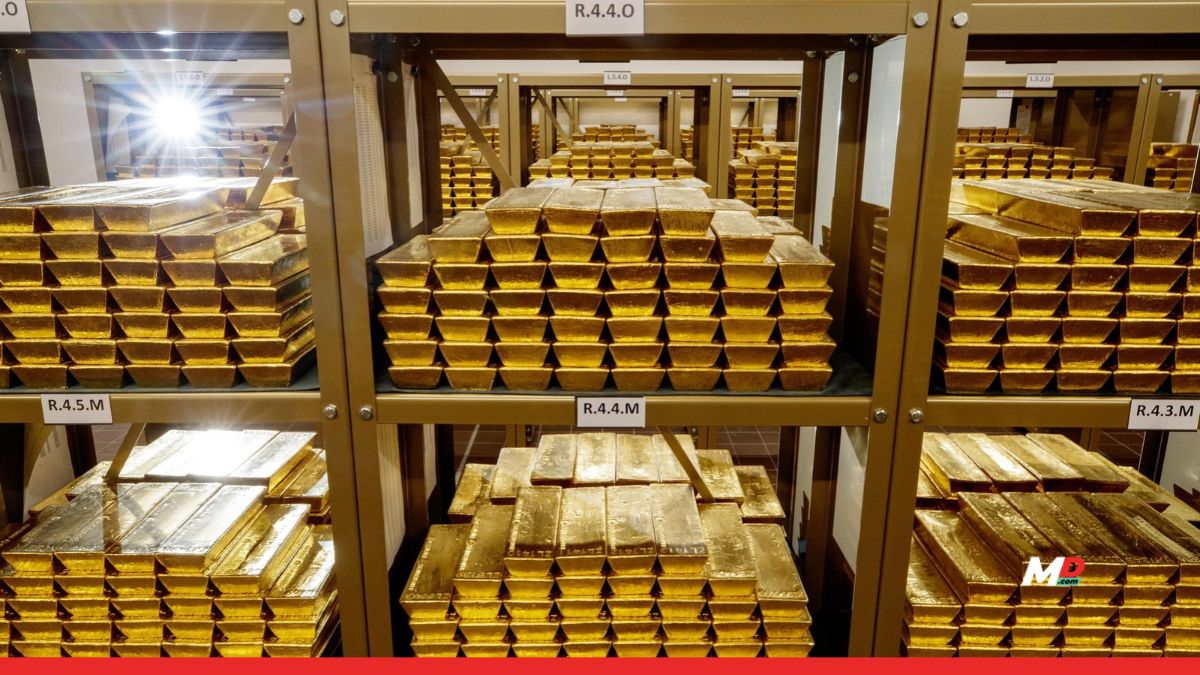
Global central banks accumulated 675 tonnes of gold in the first nine months of 2026, even as bullion suffered a sharp correction from its January record. The divergence between institutional buying and market prices raises a bigger question: is gold undergoing a temporary correction, or are investors witnessing a fundamental shift in the global financial order?
When the world’s largest financial institutions continue buying an asset while its market price is falling sharply, investors have every reason to pay attention.
That is precisely what is happening in the global gold market.
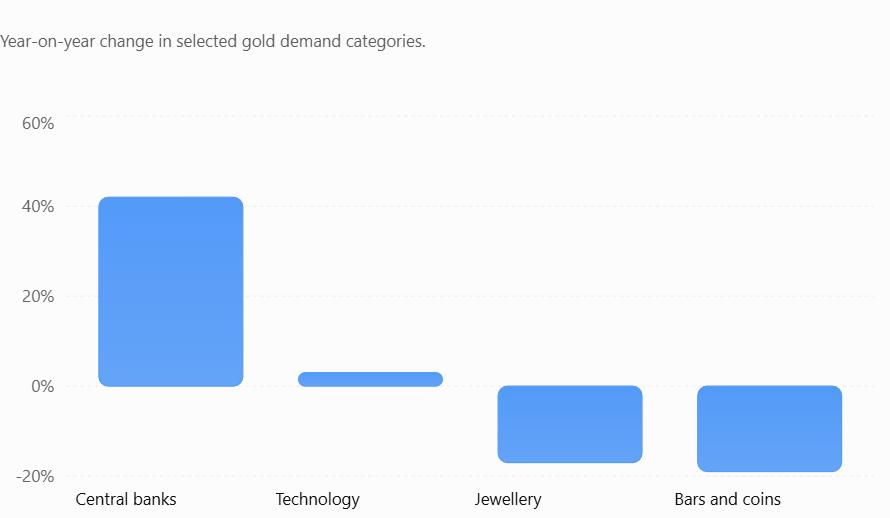
Central banks purchased an estimated 675 tonnes of gold between January and September 2026, representing a 6% increase over the corresponding period last year. More strikingly, purchases accelerated to 321 tonnes in the third quarter alone, a 42% increase year-on-year.
The buying continued even as international gold prices experienced a substantial correction from their January record levels.
According to the World Gold Council, the international benchmark price fell from a record closing level of approximately US$5,417 per ounce in January to around US$3,538 on November 20.
This divergence presents an interesting investment puzzle.
If governments and central banks continue accumulating gold, why are market prices falling? And more importantly, should individual investors interpret this as a buying opportunity?
The answer requires looking beyond the daily movement of bullion prices and understanding what gold represents in the changing global financial system.
The Numbers Behind the Central Bank Gold Rush
The latest World Gold Council Gold Demand Trends report for the third quarter of 2026 provides compelling evidence of sustained institutional interest.
Central banks and other official institutions added 321 tonnes to their reserves during the quarter, taking year-to-date purchases to 675 tonnes.
To put this into perspective, the average annual central-bank purchase between 2010 and 2021 was approximately 470 tonnes.
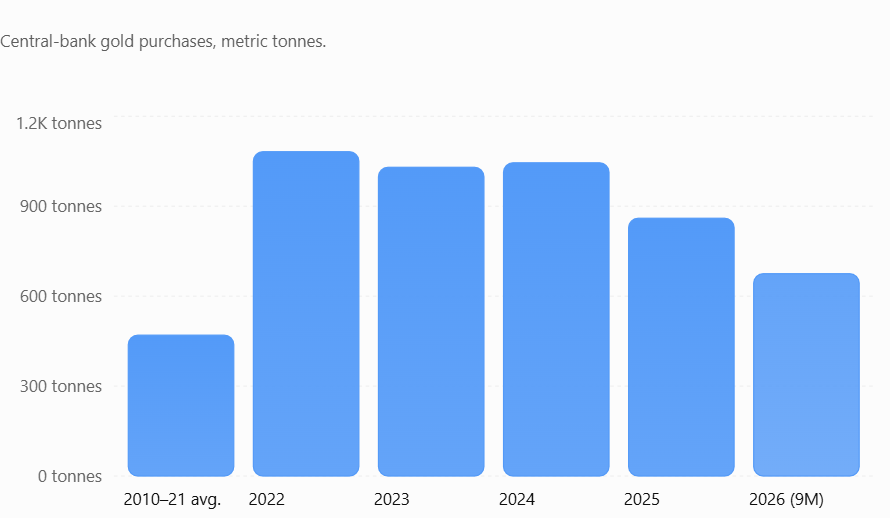
Annual purchases subsequently accelerated:
- 2022: 1,082 tonnes
- 2023: 1,030 tonnes
- 2024: 1,045 tonnes
- 2025: 860 tonnes
- 2026: 675 tonnes in the first nine months alone
The numbers suggest that central-bank accumulation has become a structural feature of the gold market rather than a temporary response to short-term price movements.
Poland and China have emerged among the largest buyers. During the first nine months of 2026, Poland reportedly added approximately 123 tonnes, while China accumulated around 103 tonnes.
Uzbekistan and Kazakhstan also increased their holdings.
Interestingly, the buying has not been universal. Turkey and Russia have reduced their holdings during parts of the year, demonstrating that central-bank reserve strategies are not uniform.
The broader trend, however, remains one of significant institutional accumulation.
Why Are Central Banks Buying Gold Despite the Price Correction?
The simplest explanation is diversification. But the underlying reasons are considerably more strategic.
1. Reducing dependence on the US dollar
For decades, the US dollar has occupied a dominant position in international trade and foreign exchange reserves.
However, geopolitical tensions, economic sanctions and changing international trade relationships have encouraged several countries to reconsider the composition of their reserves.
Gold offers an alternative because it is not a liability issued by another government or central bank.
It does not depend on the creditworthiness of a sovereign borrower and cannot be frozen through the same mechanisms as foreign financial assets held within another country’s jurisdiction.
For central banks seeking to diversify geopolitical and financial risks, this characteristic is particularly attractive.
2. Protection against long-term monetary uncertainty
Rising government debt, inflation concerns and questions about long-term fiscal sustainability have strengthened gold’s appeal as a reserve asset.
Unlike currencies, gold cannot be created through monetary policy.
Its supply is constrained by mining, recycling and existing above-ground stocks.
This makes it an attractive component of long-term reserve management, particularly for institutions concerned about purchasing-power erosion.
3. Portfolio diversification
Central banks are not necessarily buying gold because they expect its price to rise next week or next month.
They are incorporating it into broader reserve-management strategies.
Gold has historically offered diversification benefits during certain periods of currency instability, geopolitical uncertainty and financial stress.
Its effectiveness varies across market conditions, but its role as a strategic reserve asset remains significant.
Why Is Gold Falling If Institutional Demand Remains Strong?
This is perhaps the most important question for individual investors.
The answer is that central-bank purchases are only one part of the global gold market.
Prices are determined by the interaction of institutional demand, investment flows, jewellery consumption, currency movements, interest rates, futures positioning and broader liquidity conditions.
Several factors have contributed to the recent correction.
Higher interest rates and bond yields: Gold does not generate interest or dividends. When government bonds offer more attractive real yields, the opportunity cost of holding bullion increases.
A stronger US dollar: Since international gold is priced in dollars, a stronger dollar can make bullion more expensive for buyers using other currencies and put downward pressure on prices.
Profit booking: Following a substantial rally, investors may sell gold to lock in gains or raise cash for other investments.
Leveraged investor unwinding: When financial markets experience volatility, leveraged investors may be forced to liquidate positions to meet margin requirements. Such selling can accelerate price corrections even when longer-term fundamentals remain intact.
Retail demand fatigue: Higher prices have also affected physical gold demand. According to the World Gold Council, global jewellery demand fell 17% year-on-year in Q3 2026, while bar and coin demand declined 19%.
This distinction is important. Central banks can continue accumulating gold while retail investors reduce their purchases and financial-market participants unwind positions.
The two trends can coexist.
The Unreported Gold Purchases: What Investors May Be Missing
One of the more intriguing aspects of the latest data is the difference between estimated central-bank purchases and publicly disclosed transactions.
Of the 321 tonnes of estimated official-sector purchases during Q3 2026, only approximately 120 tonnes were publicly reported at the time.
This means around 63% of estimated buying was not reflected in disclosed country-level transactions.
The World Gold Council uses estimates to account for purchases that may not be immediately reported or publicly disclosed.
This is particularly relevant because central banks do not always announce reserve adjustments in real time.
Consequently, publicly available purchase announcements may not capture the full extent of institutional demand.
However, investors should avoid assuming that all unreported purchases represent deliberate secrecy or coordinated efforts to replace the dollar. Reporting delays, incomplete disclosures and estimation methodologies can all contribute to the difference.
The larger takeaway is that the official-sector demand picture is more complex than publicly announced transactions suggest.
The Indian Investor’s Perspective: Should You Buy Gold Now?
For Indian investors, the international gold correction presents a particularly interesting situation.
Gold plays a unique role in Indian households, combining investment value, cultural significance, jewellery demand and long-term wealth preservation.
However, investors must distinguish between international bullion prices and domestic gold prices.
Indian gold prices are influenced by several additional factors:
- The rupee’s movement against the US dollar.
- Import duties and applicable taxes.
- Domestic premiums and supply conditions.
- Local jewellery and physical investment demand.
Therefore, a decline in international gold prices does not necessarily translate into an identical decline in domestic prices.
The current correction may provide an opportunity for investors who have limited gold exposure or are looking to rebalance their portfolios. But central-bank purchases alone are not sufficient reason to invest aggressively.
The objective should be strategic allocation rather than speculation.
Five Things Gold Investors Should Consider Before Making Their Next Move
1. Avoid investing the entire amount at once
Gold can remain volatile even when long-term demand remains supportive. Investors considering additional exposure could spread purchases over several instalments rather than attempting to identify the exact market bottom.
A staggered approach reduces the risk of committing all available capital at an unfavourable price, although it does not eliminate investment losses.
2. Treat gold as a portfolio diversifier, not the entire investment strategy
Gold can provide diversification and act as a hedge against certain economic and geopolitical risks.
However, it does not generate regular income, dividends or business earnings.
Investors should avoid concentrating their wealth in a single asset simply because central banks are buying it.
3. Understand the different investment routes
Indian investors have several ways to gain exposure to gold:
- Gold ETFs: Provide exchange-traded exposure to domestic gold prices without requiring physical storage.
- Gold mutual funds: Offer exposure through fund structures that typically invest in gold ETFs.
- Physical gold: Coins and bars can serve as tangible holdings, although storage, purity and transaction costs need consideration.
- Jewellery: Primarily serves consumption and cultural purposes, with making charges and resale deductions affecting investment returns.
Investors should compare costs, liquidity, taxation and product structures before choosing an instrument.
4. Watch the US dollar and real interest rates
Gold’s international price is particularly sensitive to changes in the US dollar and inflation-adjusted bond yields.
If real yields continue rising and the dollar strengthens, gold could face further pressure even if central banks maintain their buying programmes.
Conversely, falling real yields and renewed geopolitical uncertainty could support bullion demand.
5. Rebalance rather than react emotionally
Investors who already have substantial gold exposure should assess whether the asset has become an outsized component of their portfolio.
A market correction should not automatically trigger panic selling, just as strong institutional purchases should not automatically trigger aggressive buying.
The right decision depends on investment objectives, liquidity requirements and overall portfolio allocation.
What Should Investors Watch Over the Next Six Months?
The direction of gold prices will depend on several developments rather than central-bank buying alone.
Four indicators deserve particular attention:
Federal Reserve policy: Changes in US interest rates and real yields could influence the attractiveness of non-yielding assets.
Central-bank accumulation: Whether official-sector purchases continue at elevated levels will provide insight into the strength of structural demand.
Gold ETF flows: Institutional and retail investment flows can significantly influence short-term market movements.
Geopolitical and fiscal developments: Sovereign debt concerns, currency instability and geopolitical tensions could renew demand for traditional safe-haven assets.
The World Gold Council expects central-bank demand in 2026 to at least match 2025 levels, following stronger-than-expected purchases in the third quarter.
However, this is not a guarantee of rising prices.
The Bigger Picture: Gold Is Becoming More Than a Safe-Haven Investment
The latest gold-buying trend reflects a broader transformation in how governments and financial institutions think about wealth preservation.
For central banks, gold is not simply a commodity whose value fluctuates with market sentiment. It is a strategic reserve asset that can provide diversification outside the traditional financial system.
For individual investors, the equation is different.
Gold can help protect purchasing power, diversify portfolios and provide a measure of resilience during periods of uncertainty. But it can also experience sharp corrections, particularly when interest rates, currency movements and speculative positioning turn against it.
The current market divergence offers a valuable lesson: institutional conviction and short-term market performance do not always move together.
The 675 tonnes accumulated by central banks are an indication of sustained strategic demand, not a guaranteed price floor.
The smartest gold investor may not be the one who buys the most during a correction, but the one who understands why gold belongs in their portfolio, how much exposure is appropriate and when to resist the temptation to follow the crowd.