Sports
The Asia Cup Final was a tale of a snub overshadowing a thrilling win

The final of the Asia Cup in Dubai, an exhibition of exquisite skill and nerve that saw India successfully defend their title against Pakistan, should have been a moment of pure, unadulterated sporting triumph.
Yet, what transpired in the aftermath was not a celebration of the victor, but a painful, protracted political skirmish that only confirmed the game’s increasing vulnerability to the geopolitical currents of the subcontinent. It became less a discussion of cover drives and seam movement, and more a lamentable narrative of poor diplomacy and profound disrespect.
The first, subtle crack appeared even before the first ball was bowled. The Indian team, as they have before, declined the customary handshake with their Pakistani counterparts. That act signalled a deep-seated tension, which victory did little to mollify. In cricket, the handshake is the ultimate expression of acceptance, a nod to the shared struggle, and its omission was the first significant transgression against the spirit of the game.
There was more to come, however, at the presentation ceremony. A spectacle designed to honour achievement became a stage for political theatre. Mohsin Naqvi, Chairman of the Asian Cricket Council (ACC), and concurrently, Pakistan’s Interior Minister, stood ready to present the trophy. The refusal of the Indian team to advance and receive the cup from his hands was a profound and deliberate snub. It was an act of public defiance, a clear attempt to bypass the individual based on his government portfolio.
Naqvi, perhaps stumped, eventually had the prestigious trophy taken out of the stadium without handing it over. The image of the silverware disappearing down the tunnel, denied its rightful place in the immediate embrace of the champions, rendered the entire tournament’s conclusion a damp squib.
From the stadium, the fracas instantly moved into the digital and political arena. Indian Prime Minister Narendra Modi, congratulating the victorious team, chose to infuse the win with nationalist fervour, likening the achievement to ‘Operation Sindoor‘, an analogy charged with military and historical significance. It was an unfortunate decision that instantly converted a sporting contest into a proxy for national pride rooted in conflict.
Naqvi, dropping the administrative neutrality expected of an ACC chief, responded in kind. His riposte to the Prime Minister’s comparison was direct and equally inflammatory, dragging the discourse of warfare directly into cricket. His choice of words, which questioned the wisdom of using war as a measure of sporting pride, was a staggering breach of the protocol that should insulate the sport from such heavy-handed political rhetoric.

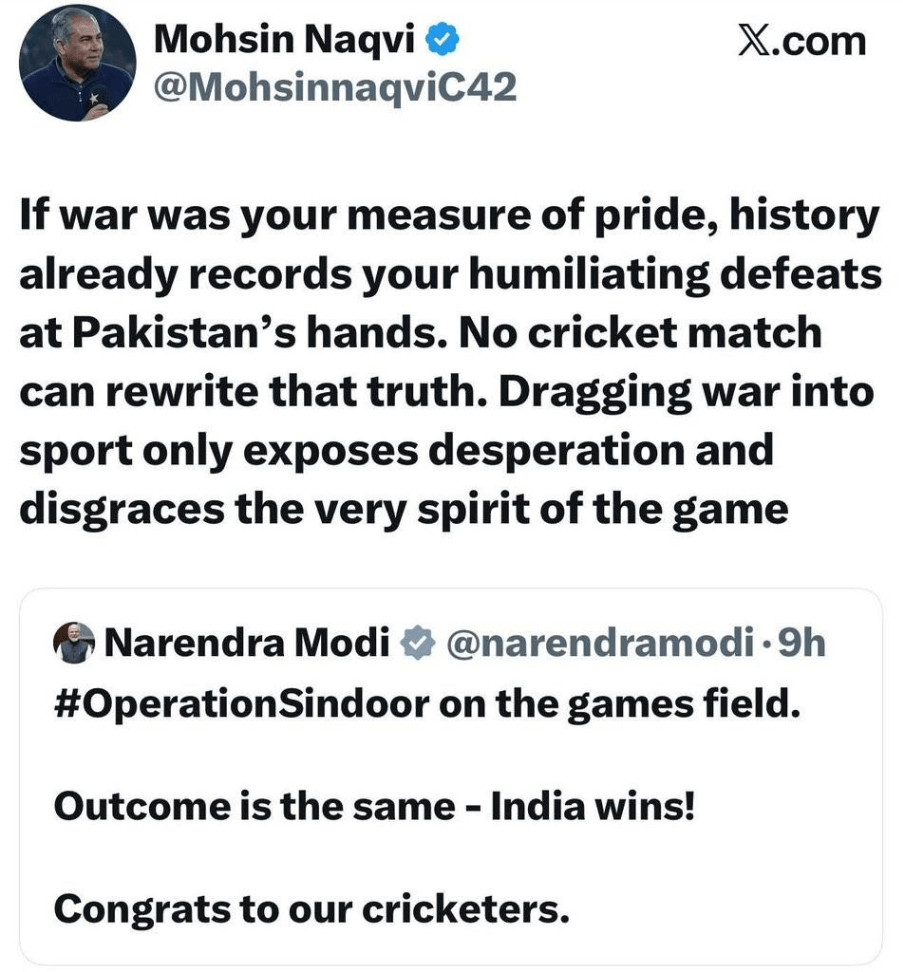
Analysing this sorry episode, it is clear there are no mitigating factors sufficient to excuse the behaviour exhibited by all principal players. This was a monumental failure of statesmanship within the sporting fraternity. Naqvi, wearing the dual identity of a high-ranking government official and an international cricket administrator, should have meticulously avoided any action that conflated the two roles, and his reply to Mr. Modi was an astonishing error of judgment.
Yet, the initial act of provocation lay with the Indian team. The refusal to engage in the universally accepted cricket customs—the handshake, the acceptance of the trophy from the designated authority—was an act of petulance.
Cricket is often called the Gentleman’s Game not because the contests are gentle, but because of the expected adherence to certain standards of conduct that transcend victory and defeat. When the political baggage of the two nations becomes so heavy that a victorious team cannot perform a simple courtesy or accept a symbolic award without controversy, the game itself suffers an irreparable loss of integrity. The thrill of the contest, the brilliance of the performances, and the drama of a final against the fiercest rival, are now rendered footnotes to a saga of poor sportsmanship and political opportunism.
It is a sombre reflection that the victory at the Asia Cip, for all its glory, will forever be associated with the unseemly squabble that stained the hallowed turf of international cricket.