Politics
‘If you don’t want Sanchar Saathi, you can delete it’: Minister defends mandatory app order

The chasm between official policy and public reassurance has rarely been wider than it is this week. While the government insists its new mandatory mobile application is optional for the end-user, the fine print of the Department of Telecommunications’ latest directive suggests a far more permanent, and potentially intrusive, digital reality for Indian citizens.
The controversy centers on a directive issued by the AI & Digital Intelligence Unit of the DoT regarding the ‘Sanchar Saathi’ application. Ostensibly designed to curb IMEI fraud and improve telecom security, the order mandates the pre-installation of this software on all mobile handsets manufactured or imported for use in India.
However, the true point of friction lies in the disparity between the legal text and the political messaging. The Minister has gone on record to state that “if you don’t want Sanchar Saathi, you can delete it,” attempting to quell fears of a surveillance state. Yet, this verbal guarantee creates a direct paradox when placed alongside the written law.
A close reading of the directive, specifically Clause 7(b), paints a picture that is diametrically opposed to the Minister’s claims. The clause explicitly commands manufacturers to ensure that the pre-installed application is not only readily visible but that “its functionalities are not disabled or restricted.” In the rigid lexicon of bureaucratic orders, this does not suggest an optional utility that can be casually uninstalled.

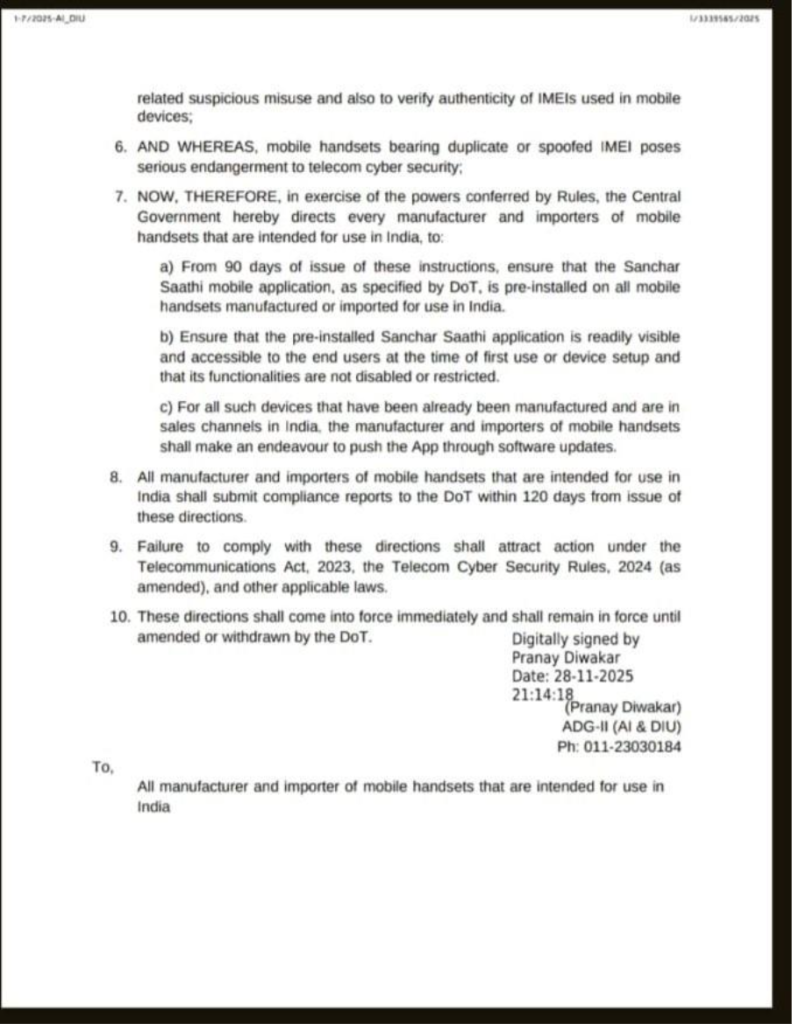
It implies a piece of software baked into the firmware, potentially requiring system-level or root access to function as intended. If the app cannot be disabled, it effectively converts every smartphone sold in India into a vessel for state-mandated software that the user cannot meaningfully refuse.
The Internet Freedom Foundation has rightly flagged this as a sharp expansion of executive control. They argue that even if the objective of checking device genuineness is valid, the means chosen are grossly disproportionate. The government already possesses less intrusive tools for IMEI verification, such as web portals and SMS-based services, which do not require a permanent resident application on a user’s personal device. By forcing a non-removable app for a sporadic verification task, the state fails the proportionality test established in the landmark K.S. Puttaswamy judgment on privacy.
Furthermore, the ambiguity regarding the app’s technical privileges is alarming. For an app to remain “not disabled” by default, it requires privileges that override user autonomy. This architecture invites what privacy advocates call “function creep.” Today, the app is an IMEI checker. Tomorrow, a server-side update could theoretically repurpose that same privileged access for client-side scanning, VPN flagging, or message trawling. The directive’s vague language regarding “telecom cyber security” offers no functional perimeter to prevent such an evolution.
Therefore, the Minister is left with two uncomfortable possibilities. Either he is misrepresenting the facts to pacify a concerned public, or there has been a frantic, unwritten rollback in the government’s position that has yet to be reflected in the legal text. Until the DoT issues a formal amendment retracting Clause 7(b), the written order remains the law of the land.
Verbal assurances carry no legal weight against a gazetted directive that threatens action under the Telecommunications Act for non-compliance. Sustained public uproar is essential to cut off this super-snooper lurking in the shadows, for a democracy cannot rely on the benevolence of an app that its own laws say cannot be deleted.