Politics
CJP claims Dipke ‘picked up’ by Police as protesters meet Nadda

Monday’s ‘Chalo Sansad’ march by the Cockroach Janta Party (CJP) turned chaotic through the day, with the group alleging that founder Abhijeet Dipke was picked up by Delhi Police even as its representatives were inside BJP president JP Nadda’s residence for talks.
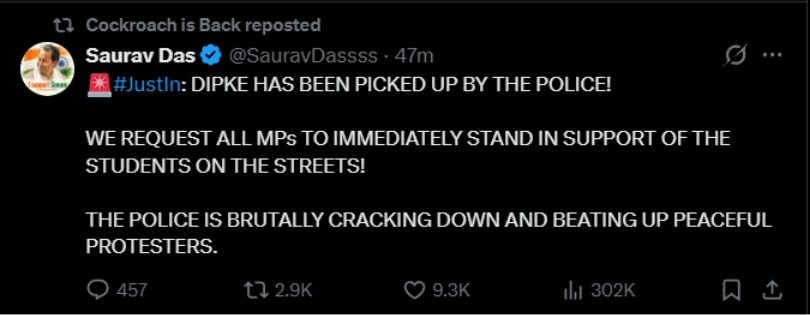
CJP chief spokesperson Saurav Das made the claim on X, saying Dipke had been picked up and appealing to MPs to stand with the students on the streets, alleging that police were beating peaceful protesters. The claim came hours after Dipke had ended his own indefinite hunger strike, at Sonam Wangchuk’s request, having begun the fast after Wangchuk was hospitalised on 18th July following his 21-day strike.

Protesters met with lathi charges and tear gas
The march, which began at Jantar Mantar, ran into resistance early. Protesters were first stopped with a lathi charge as they tried to move towards Parliament. A second round followed around noon, as demonstrators again attempted to push forward. By the afternoon, police had fired tear gas near Raisina Road, barely 200 metres from Parliament, and a police sub-inspector was reported injured in a clash after protesters allegedly pelted stones. Prime Minister Narendra Modi left the Parliament premises around noon, with entry gates shut soon after.
Delhi Police cited a standing advisory prohibiting marches, processions and gatherings of five or more people anywhere except the designated Jantar Mantar site with prior permission, given the heightened security around the Monsoon Session’s opening day.
The protest drew a wide cast of political visitors. AAP leaders Manish Sisodia, Sanjay Singh and Atishi arrived at Jantar Mantar to join the march. Later in the afternoon, Samajwadi Party MPs Dimple Yadav and Dharmendra Yadav were detained by police while participating in the protest, with the Samajwadi Party calling the action against the MPs and the lathi charge on students ‘condemnable and undemocratic’.
Alongside the street confrontation, a parallel track of dialogue was playing out. CJP representatives Ashutosh Ranka and Saurav Das travelled to JP Nadda’s residence, and after waiting more than two hours, met the BJP chief for about ten minutes.
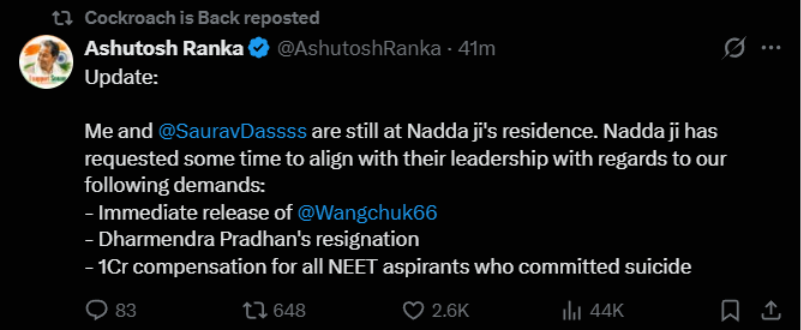
Das said on X that the duo had submitted a written letter of demands, and that Nadda had assured them he would speak internally within the party and take the matter forward. Ranka, posting separately, said the two were still at Nadda’s residence and that Nadda had asked for time to align with the party leadership on three demands: the immediate release of Wangchuk, the resignation of Union Education Minister Dharmendra Pradhan, and a compensation of one crore rupees for the families of NEET aspirants who had died by suicide.

Das noted that the government had reached out for talks earlier in the morning, and struck a defiant note even as news of detentions spread, saying the youth had gathered in huge numbers and that the demands were clear.
Wangchuk, for his part, had earlier written to the Medical Superintendent at Safdarjung Hospital seeking permission to leave, even temporarily, to join the march, saying his health parameters were normal. It is not yet clear whether that request was granted.
The resilience of cockraoches
The scale of the response reflected how far CJP has travelled since its founding in mid-May. What started as a satirical rejoinder to a Chief Justice’s remarks about unemployed youth has, within weeks, drawn crowds large enough to shut down traffic around one of Delhi’s most sensitive security zones, and pulled in leaders from the Aam Aadmi Party and the Samajwadi Party in a show of solidarity. That an outfit built on irony now finds itself the subject of both a lathi charge and a closed-door meeting with the president of the ruling party says something about how quickly the protest has been taken seriously, whatever the government’s public posture on it continues to suggest.
By Monday evening, the day had produced two starkly different narratives: a government-facing track, where a senior BJP leader had met protest representatives and promised internal consultation, and a street-facing one, marked by lathi charges, tear gas and the reported detention of the movement’s founder along with sitting MPs. How the two reconcile, and whether Nadda’s assurance leads anywhere concrete, will likely shape the week ahead.