Politics
The Cockroach is India’s most viral and unlikely political superstar

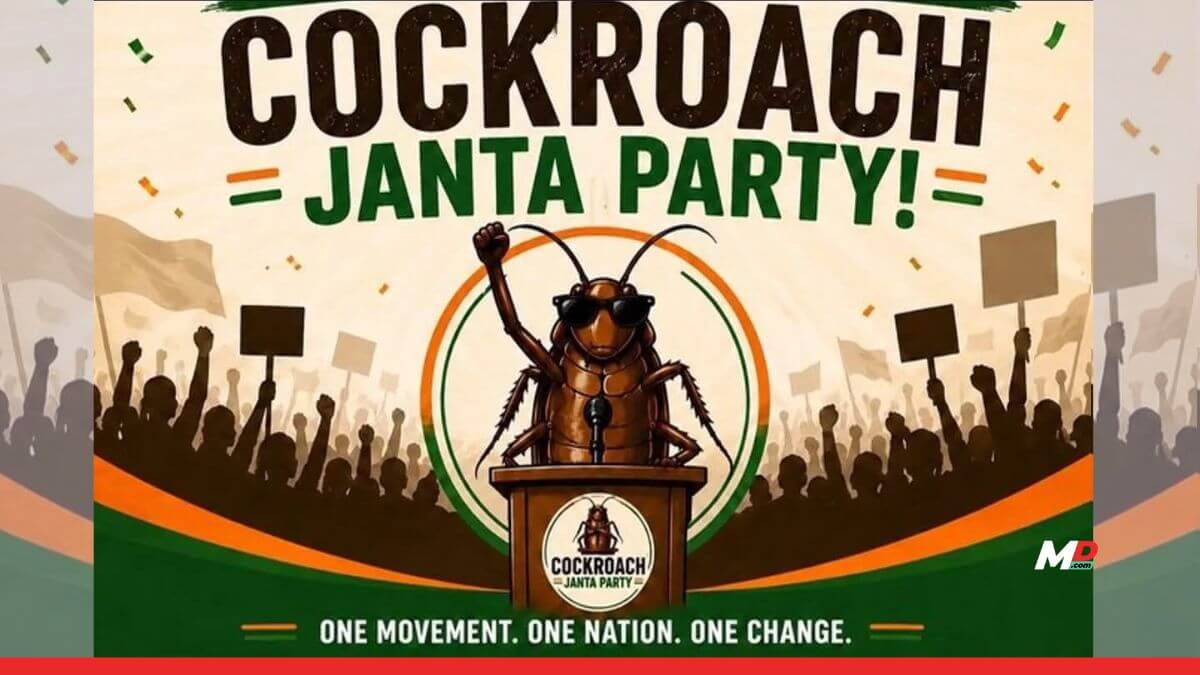
It started with a throwaway remark by one of India’s most powerful jurists. It ended, within a week, with a satirical political outfit outpacing the ruling party on Instagram and getting its X account withheld by the Indian government. The story of the Cockroach Janata Party is many things at once: a comedy, a protest, a stress test of digital free expression, and possibly the most precise mirror that Indian youth have held up to power in years.
On May 15, Chief Justice of India Surya Kant, speaking during a court hearing on the designation of senior advocates, described unemployed young people entering the legal profession using fake degrees as being like “cockroaches” and “parasites.” The CJI later walked back the remark, clarifying that his target was those with fraudulent credentials, not unemployed youth at large. By then, it did not matter. The internet had already caught fire.
Abhijeet Dipke, a 30-year-old political communication strategist currently studying at Boston University, was among those who saw the comment and felt the sting. On May 15, he posted a single question on X: “What if all cockroaches came together?” It was a joke. It became a movement.
Within days, Dipke had set up a website, a Google membership form, and social media accounts for the Cockroach Janata Party, abbreviated CJP, a deliberate echo of the ruling Bharatiya Janata Party. The membership criteria were simple: be unemployed, be able to professionally rant. The party motto read “Secular, Socialist, Democratic, Lazy.” But underneath the self-deprecating branding was a manifesto with real political teeth: no Rajya Sabha seats for retiring Chief Justices, UAPA charges for election commissioners who allow voter rolls to be deleted, a free press, and a 20-year ban from public office for party defectors.
“Those in power think citizens are cockroaches and parasites,” Dipke told Al Jazeera from Chicago. “They should know that cockroaches breed in rotten places. That’s what India is today.” It was a line that captured the collective exhaustion behind what had seemed, on the surface, like a meme.
The numbers that followed were staggering. In four days, the CJP’s Instagram account crossed 10.9 million followers, eclipsing the BJP’s 8.7 million. It did this with 56 posts, compared to the BJP’s 18,000-plus. Over 350,000 people signed up for membership via a Google Form. The party’s X account accumulated over 165,000 followers before it was withheld. Support came from unexpected corners of the political establishment: Trinamool Congress’s Mahua Moitra, Samajwadi Party chief Akhilesh Yadav, and activist-lawyer Prashant Bhushan all amplified the movement.
The government’s response came soon after. X’s page for the Cockroach Janata Party now displays a standard notice: the account has been withheld in India in response to a legal demand. Dipke’s reaction, posted on X itself, was two words: “Own goal.” Within hours of the withholding, screenshots of the blocked page were circulating across every other platform, and the phrase “withheld in India” was trending nationally. The CJP’s Instagram account, meanwhile, continued to grow, approaching Congress’s follower count next.
Under X’s content moderation policy, accounts may be withheld in specific countries in response to legal requests or local laws while remaining accessible elsewhere. The platform does not typically disclose the nature of the legal demand. What the move did accomplish, unambiguously, was to amplify the story. By attempting to restrict a satirical page, the government handed the CJP a narrative gift: proof, in the eyes of its supporters, that those in power were watching and worried.
The CJP phenomenon sits at an intersection that Indian digital culture has been building toward for years. Meme politics, youth unemployment, judicial accountability, and the growing assertiveness of online civic identity have all been present as separate threads.
The Cockroach Janata Party pulled them together, briefly, under an absurdist banner that made dissent feel accessible rather than dangerous. Whether it translates into anything durable beyond the viral cycle remains an open question. But for now, India’s unofficial opposition has 13 million followers and growing, and its X account is blocked. It remains to be seen if this cockroach too is as resilient and hard to kill off as its namesake.