Business
Public money, private bailout: LIC’s Rs. 33,000 cr. bailout of Adani causes massive stir

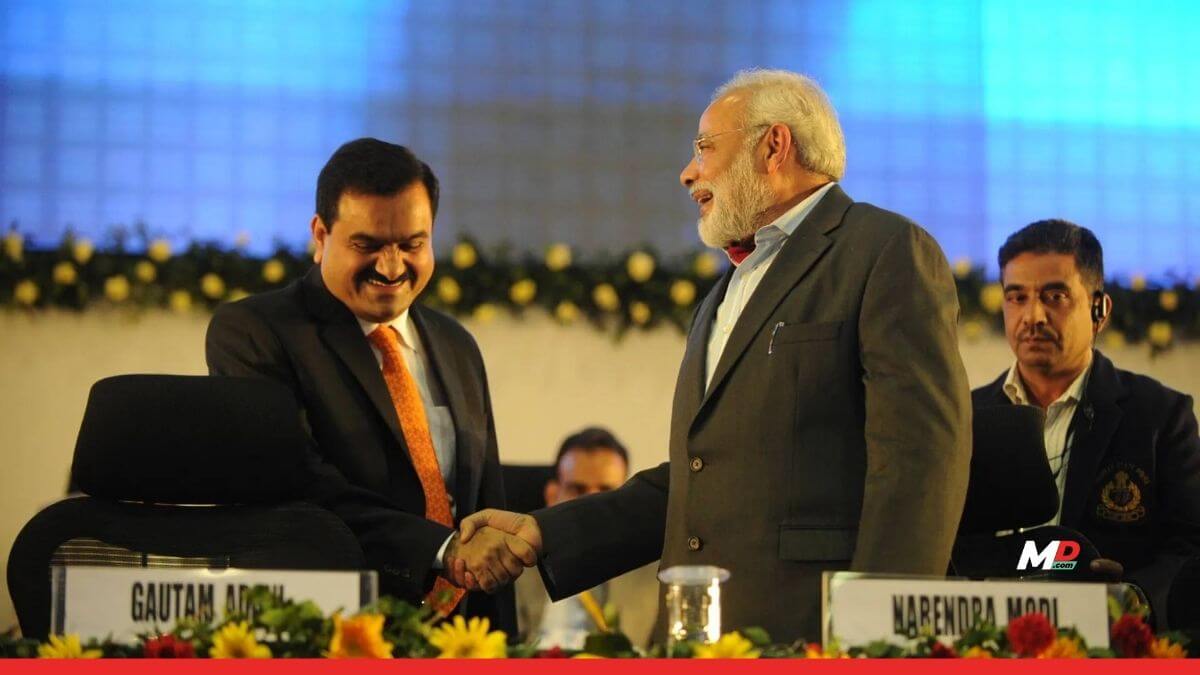
The Life Insurance Corporation of India, the nation’s largest institutional investor and the custodian of millions of policyholders’ savings, appears to have been caught between its fiduciary duty and the subtle yet overwhelming expectations of the state, according to an explosive story broken by the Washington Post.
The controversy stems from the massive public-sector bailout of Gautam Adani’s enterprise by LIC. Adani, a staunch ally of PM Modi, has seen his corporate empire rocked by damaging charges from Hindenburg Research, a now shuttered US short-seller.
As billions of dollars in market value evaporated, the spotlight turned immediately to LIC, which reportedly held significant stakes in the embattled conglomerate. The suspicion is not merely about poor investment timing; it centers on the allegation that LIC was goaded, cajoled, and guided by political forces to use Rs. 33,000 crores of public funds as a financial shield for a key private corporate player.
This alleged intervention represents a disturbing textbook example of crony capitalism, where the institutional independence of a critical financial body is compromised to serve private interests deemed politically essential. LIC is not a national contingency fund; it is a financial entity whose primary and non-negotiable mandate is to safeguard the maturity payments and bonuses of its policyholders.
When the state, implicitly or explicitly, directs such an institution to invest over Rs. 30,000 crores into a single private group during a volatile crisis—a move widely labeled by the political opposition as an “Adani bailout”—the savings of everyday Indians are placed in direct, unwarranted jeopardy. This act fundamentally blurs the critical line separating state governance from private financial gain, raising questions about whether regulatory bodies can truly act independently when the stakes involve high-ranking political proximity.
The subsequent attempts by LIC to manage the narrative only deepened the crisis of trust. In response to mounting public and political fury, including demands for a joint parliamentary committee probe, LIC issued a rebuttal denying “false Adani investment claims.”
The very nature of this denial, however, was highly irregular and instantly suspicious to seasoned observers. The statement was released purely on a corporate letterhead, a cold, clinical document conspicuously devoid of a single high-ranking official’s signature. This lack of personal accountability is a glaring anomaly for a corporation of LIC’s stature, particularly when addressing an issue of such magnitude that threatens institutional credibility and national security.
The absence of a signatory—no Chairman, no Managing Director, no Executive Director—speaks volumes. It creates an institutional vacuum of responsibility, almost as if the highest echelons of LIC’s corporate leadership deliberately positioned themselves to avoid any personal or professional liability. The message this omission sends is clear: the corporate masters wished to issue a formal denial to placate markets and political overseers, but simultaneously did not want their names publicly affixed to the defense in case the situation went south. This move suggests an institutional cynicism and a fear of future accountability, implying that the executives themselves harbor doubts about the long-term defensibility of the investments or the propriety of the directives received from above.
Contrast this with the standard procedure of any major financial entity facing severe public scrutiny, where statements are invariably endorsed by a named, senior executive to lend weight and authority to the content. LIC’s decision to hide behind its letterhead transforms the denial from an assertion of fact into a cautious, almost reluctant acknowledgment of external pressure. This failure of corporate courage reinforces the very allegations it sought to counter, suggesting that the pressure to defend the group was governmental, not fiduciary.
The incident is a chilling case study of how the mechanisms of cronyism operate. It is not always about overt orders but often about a pervasive political atmosphere where public institutions intuitively understand their role is to serve the political leadership’s interests first. This alleged weaponization of LIC, funded by the mandatory premiums of millions of citizens, sets a dangerous precedent. It transforms the nation’s most trusted insurer into a tacit government tool for propping up favoured private ventures, fundamentally undermining the principles of fair market competition and robust financial independence.
Until a signed, transparent, and detailed justification for the investments is provided by a named official, the corporate shadow over LIC’s leadership will persist, leaving the Indian public to wonder who truly commands their life savings. The political opposition’s demands for a thorough probe are no longer merely political posturing; they are a necessary call to restore the foundational trust in India’s democratic and financial institutions.