Business
US Federal Reserve hikes rates for the first time since 2023

The Federal Reserve’s first rate hike since 2023 has changed the global market conversation from when rates might fall to how high they could go from here. On September 16, the US central bank raised the federal funds target range by 25 basis points to 3.75%-4%, citing persistent inflation, solid economic activity, and a stable labour market. The FOMC decision was unanimous.
More important for markets, the Fed’s updated projections point to one more rate increase in 2026, followed by a hold through 2027. Inflation is expected to remain above the 2% target for longer, while economic growth is still projected at 2.3% this year.
The return of higher-for-longer
“The Fed Chair described the hike as removal of a dose of accommodative financial conditions,” says Sreejith Balasubramanian, Senior Economist – Fixed Income, Bandhan AMC. He notes that the decision reflects the Fed’s concern over inflation and its desire for a “timelier return” to the 2% goal.
The immediate 25-basis-point move was broadly anticipated, meaning the bigger market signal lies in the trajectory. Balasubramanian points out that rate-hike expectations had already increased over the previous three weeks, following concerns around robust job additions, higher core CPI, and rising oil prices.
US Treasury yields had also been moving higher amid fiscal concerns, stronger-than-expected growth, and increasing debt financing associated with the AI investment boom. The 10-year/2-year Treasury spread had consequently been narrowing, while the dollar had strengthened.

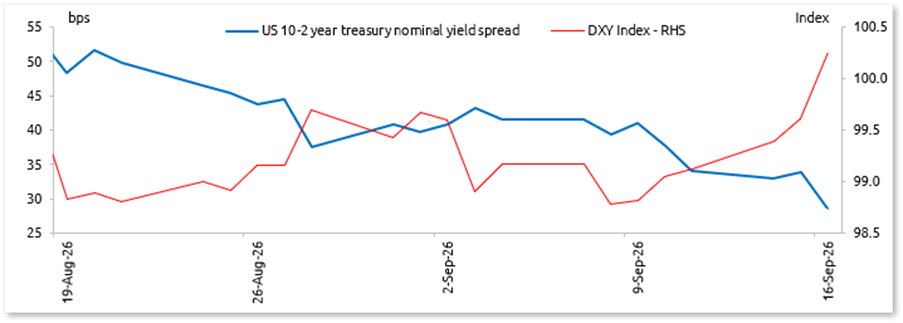
10y-2y US treasury yield spread has eased while the USD has Risen
Source: Bloomberg, Bandhan MF Research
That combination creates a difficult backdrop for risk assets. Higher Treasury yields raise the return investors can earn from relatively low-risk US government debt, potentially reducing the relative appeal of equities and other riskier assets. Growth and technology stocks can be particularly sensitive because higher discount rates reduce the present value investors place on future earnings.
Emerging markets feel the pressure
The effects do not stop at Wall Street. A stronger dollar and higher US yields can encourage global investors to move capital towards dollar assets, putting pressure on emerging-market currencies and local bond markets.
India is particularly exposed because of its dependence on imported energy. Brent crude was trading around $108 a barrel before the Fed decision, while the rupee was already near 96 to the dollar.
Balasubramanian notes that inflationary pressures in India have also been rising because of higher oil and commodity prices, uneven monsoon rainfall, buoyant GDP growth, and strong credit growth. At the same time, India’s monetary policy has been gradually loosening.
That leaves the RBI with a more complicated balancing act. “We therefore expect the RBI to deploy a combination of temporary and permanent measures to absorb the excess liquidity from its recent special swap schemes, and to hike policy rates by 75bps by April next year,” Balasubramanian says.
Also read: Japan Rate Hike Could Trigger Shockwave in Indian Markets
The market’s next question
The Fed’s hike, therefore, is less about the quarter point itself and more about the possibility that the era of rapidly falling global rates has ended. US 10-year Treasury yields finished around 5% after the decision, while the two-year yield rose to about 4.73%.
For global markets, the watchpoints are now clear: US inflation, oil prices, Treasury yields, the dollar, and whether economic growth remains strong enough to absorb tighter financial conditions. For India, the rupee, crude, bond yields, and the RBI’s response will determine how much of the global tightening cycle reaches domestic markets.